Key takeaways
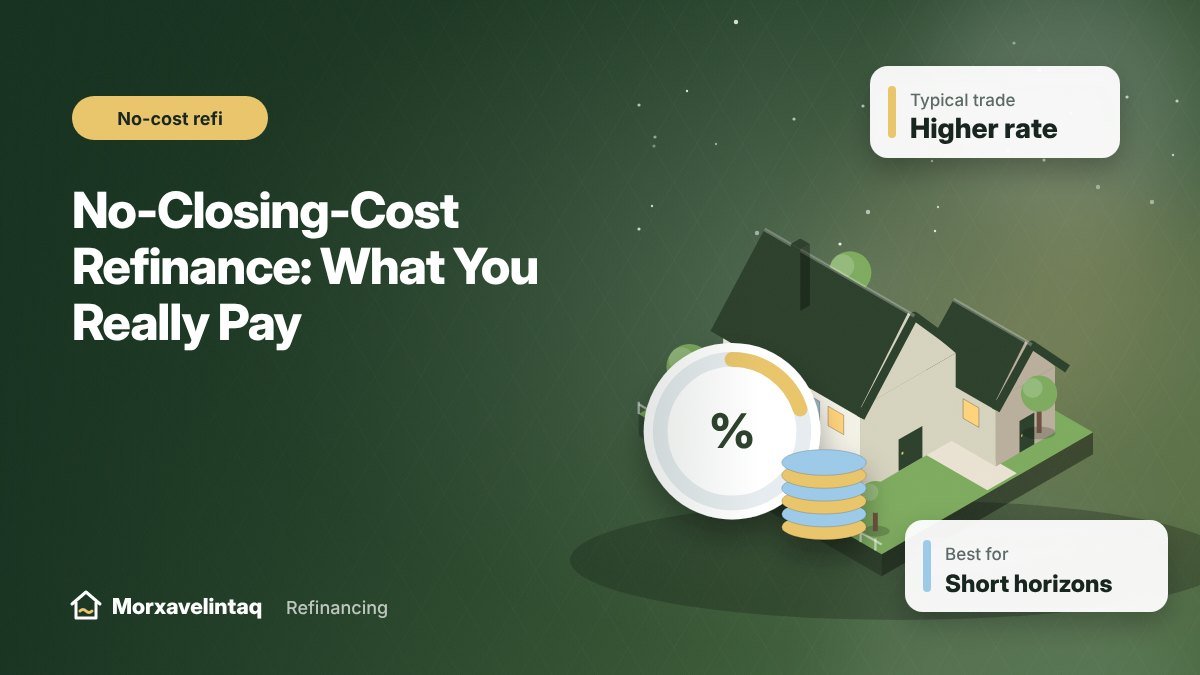
- "No-closing-cost" usually means the costs are covered by a lender credit (higher rate) or added to your loan balance.
- It's rarely truly free; you pay over time instead of upfront.
- It's a strong option if you might move or refinance again within a few years.
- Compare the no-cost rate to the standard rate and calculate how long until the standard option becomes cheaper.
Ads for "no-closing-cost refinances" make refinancing sound effortless. The concept is legitimate, but you should know which version you're getting and how much it costs over time.
Two ways lenders structure it
- Lender credits (higher rate): you accept a slightly higher interest rate, and the lender pays your closing costs with a credit. Your balance doesn't increase.
- Rolled-in costs: the costs are added to your new loan balance. You don't pay cash, but you borrow more and pay interest on those costs. Some lenders call this "no out-of-pocket," not truly no-cost.
The math behind a higher-rate, no-cost refinance
Refinancing $300,000 into a new 30-year fixed:
- Option A: 6.50% with $6,000 in closing costs. Payment: $1,896
- Option B: 6.875% with $0 closing costs. Payment: $1,971
Option B costs about $75 more per month. It takes roughly $6,000 ÷ $75 = 80 months, or 6.7 years for Option A's upfront costs to pay off. If you'll refinance or sell before then, Option B is cheaper.
When a no-closing-cost refinance makes sense
- Rates could fall further. If you might refinance again, paying upfront costs twice is expensive.
- You may move soon. A job relocation or growing family could have you selling within a few years.
- Cash is tight. Preserving savings can be worth a slightly higher rate.
- You'll still beat your current rate meaningfully. Even the higher no-cost rate saves money right away.
When paying closing costs makes more sense
- You expect to stay in the home and keep the loan for many years.
- Rates are near historic lows and unlikely to drop further.
- You can comfortably pay the costs without draining your emergency fund.
Costs that never disappear
Even with a no-cost structure, you'll typically still fund prepaid interest and a new escrow account. These aren't really fees; you'd pay them anyway, and your old escrow balance gets refunded after the old loan is paid off. Read the Loan Estimate carefully to see which items the lender credit covers.
How to compare offers
- Ask lenders for both a zero-point quote and a no-closing-cost quote.
- Calculate the payment difference and divide total costs by it.
- Compare that break-even timeline to how long you'll realistically keep the loan.
- Use our Loan Estimate comparison guide to verify the credit covers what's promised.
Example: rolled-in costs vs. lender credits
Same refinance, three structures on a $300,000 loan:
- Pay costs in cash: 6.50% rate, $300,000 balance, $1,896 payment, $6,000 out of pocket.
- Roll costs into the loan: 6.50% rate, $306,000 balance, about $1,934 payment, $0 out of pocket.
- Lender credit: 6.875% rate, $300,000 balance, $1,971 payment, $0 out of pocket.
Rolling costs in raises the payment by about $38 and adds $6,000 to the balance you'll pay interest on. The lender credit raises the payment by about $75 but leaves the balance unchanged. If you expect to sell or refinance within roughly five years, the lender credit usually costs less in total. Over a longer horizon, rolling in costs typically wins, and paying cash wins over the very long term.
Making the most of a no-cost refinance
If you choose a no-closing-cost loan because rates may fall further, keep an eye on the market. Because you didn't pay upfront costs, there's no sunk cost to recover, so even a modest future rate drop can justify refinancing again. That flexibility is the real value of the strategy. Just avoid refinancing so often that you lose track of your remaining term.
Questions to ask about a no-cost offer
- Is the lender credit covering all of my closing costs, or only lender fees?
- Are any costs being added to my loan balance?
- What would the rate be if I paid the costs myself?
- Will I need to fund prepaid interest and escrow at closing?
- Is there any prepayment penalty or restriction on refinancing again?
Frequently asked questions
Is a no-closing-cost refinance a scam?
No, it's a legitimate pricing option. Just make sure you understand whether costs are covered by a lender credit or added to your balance.
Does it affect APR?
The rate is higher, but finance charges are lower, so the APR may be similar. See APR vs. interest rate.
Can I do this on FHA or VA loans?
Yes. Streamline programs often use lender credits to cover costs.