Key takeaways
- Only current FHA borrowers can use the FHA Streamline Refinance.
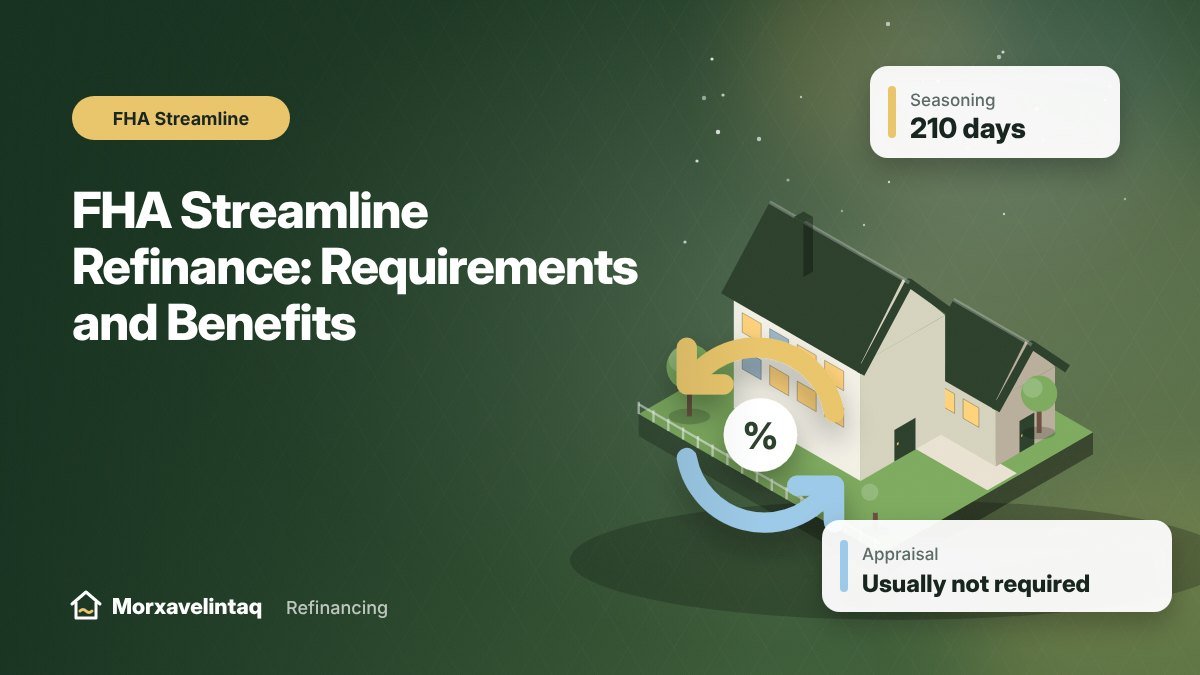
- You need at least 210 days since closing and six on-time payments.
- The new loan must provide a "net tangible benefit," usually a meaningfully lower combined rate.
- Many streamlines need no appraisal and limited income documentation, which speeds things up.
- Refinancing within three years of your original loan earns a partial refund of your upfront MIP.
If you have an FHA loan and rates have dropped, the FHA Streamline Refinance is designed to make lowering your rate as simple as possible. "Streamline" refers to the reduced documentation, not necessarily lower costs, so it pays to understand the rules.
Basic requirements
- Existing FHA loan on the property.
- Seasoning: at least 210 days since your current loan closed, and at least six monthly payments made.
- Payment history: generally no late payments in the past six months and no more than one 30-day late payment in the past 12 months.
- Net tangible benefit (below).
- No cash out beyond a small amount for adjustments, generally capped at $500.
The net tangible benefit test
FHA requires the refinance to benefit you. For a fixed-to-fixed refinance, the new combined rate (interest rate plus annual MIP rate) generally must be at least 0.5 percentage points lower than the current combined rate. Different thresholds apply when moving between ARM and fixed products, or when shortening the term. Your lender will document the calculation.
Credit-qualifying vs. non-credit-qualifying
| Non-credit-qualifying | Credit-qualifying | |
|---|---|---|
| Income verification | Not required | Required |
| Credit review | Mortgage payment history; many lenders still pull credit | Full credit review |
| When used | Same borrowers stay on the loan | Removing a borrower, or when the payment rises significantly |
Many lenders apply their own minimum credit score even on non-credit-qualifying streamlines.
Appraisal rules
Most FHA streamlines can be done without an appraisal. The new loan amount is based on your current unpaid balance, not the home's value, so even underwater borrowers can qualify. Closing costs generally can't be rolled into a no-appraisal streamline, though lenders can offer a slightly higher rate with lender credits to cover costs.
The upfront MIP refund
When you refinance from one FHA loan to another within three years, part of your original 1.75% upfront mortgage insurance premium is credited toward the new upfront premium. The refund shrinks each month and disappears after 36 months.
Mortgage insurance on the new loan
You'll pay a new upfront MIP (reduced by any refund) and annual MIP at current rates. For loans endorsed before June 2009, special reduced MIP rates may apply. Ask your lender to show the MIP math.
Example: a borrower has a $260,000 FHA balance at 7.0% plus 0.55% annual MIP, a combined 7.55%. Rates fall, and a streamline offers 6.25% plus 0.55% MIP, a combined 6.80%. The 0.75-point reduction passes the net tangible benefit test, and the payment drops by roughly $130 a month. No appraisal or pay stubs are needed.
Is a streamline always the best option?
If you now have 20% equity and good credit, refinancing into a conventional loan may eliminate mortgage insurance entirely, saving more than a streamline. Compare both with our break-even calculation.
Steps to complete an FHA Streamline
- Check your seasoning. Confirm you've made at least six payments and that 210 days have passed since your current loan closed.
- Review your payment history. Make sure your recent payments were on time.
- Get quotes from two or three FHA lenders. Ask each for the new rate, the MIP calculation, any upfront MIP refund, and whether costs are covered by lender credits.
- Confirm the net tangible benefit calculation in writing.
- Lock your rate and provide the limited documents requested, typically your mortgage statement, ID and homeowners insurance.
- Close. Because of the reduced documentation, many streamlines close in two to four weeks.
Watch the payment-skip pitch
Lenders sometimes advertise that you'll "skip a payment" by refinancing. In reality, mortgage interest is paid in arrears, and the timing of your closing simply shifts when your first new payment is due. The interest for that month is still paid, usually rolled into the new loan or collected at closing. It's a cash-flow timing effect, not free money. Evaluate a streamline on its rate and costs, not on payment-timing promises.
Frequently asked questions
Can I do a streamline with my current lender only?
No. Any FHA-approved lender can do a streamline refinance, so shop around.
Can I remove someone from the loan?
Yes, but it usually requires a credit-qualifying streamline so the remaining borrower's income and credit are verified.
Can I do an FHA Streamline on a rental property?
Yes, if the property was originally purchased as an owner-occupied FHA loan, but it must be done with an appraisal-free structure and no closing costs financed.