Key takeaways
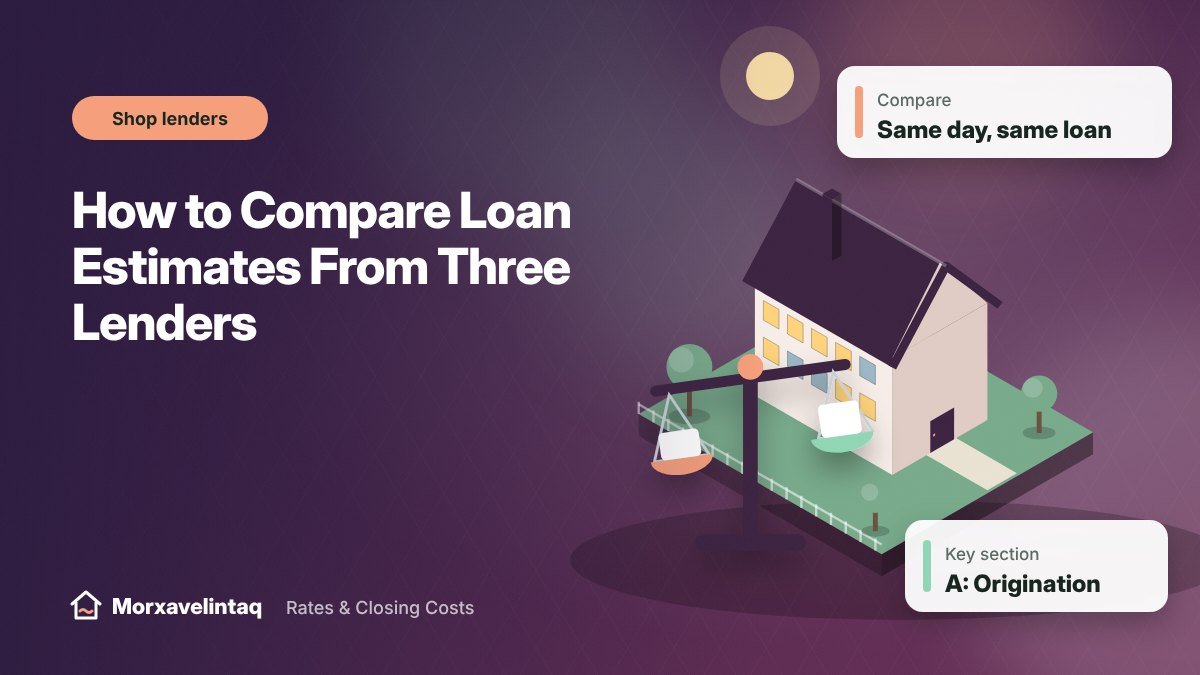
- Request Loan Estimates from at least three lenders on the same day for the same loan amount, term, loan type and lock period.
- The most comparable sections are the interest rate, Section A origination charges, and lender credits.
- Use page 3's "In 5 Years" figure to see costs over a realistic time frame.
- Ignore fees that every lender must pay to third parties, like taxes and prepaid insurance, when deciding who's cheapest.
Shopping for a mortgage can save thousands of dollars, but only if you compare the right numbers. The standardized Loan Estimate makes that possible: every lender must use the same three-page form, so you can line them up and see differences clearly.
Step 1: request comparable quotes
Give each lender identical information: purchase price, down payment, loan type, term and estimated credit score. Ask for the same lock period. Lenders must deliver a Loan Estimate within three business days after you provide six pieces of information: your name, income, Social Security number, property address, estimated value and loan amount. Rates change daily, so collect estimates on the same day if possible.
Step 2: compare page 1
- Loan amount should match across lenders.
- Interest rate and whether it's locked.
- Monthly principal and interest.
- Prepayment penalty or balloon payment: both should usually say "NO."
- Estimated cash to close.
Step 3: focus on Section A and lender credits
Section A, origination charges, is the cleanest comparison because it's entirely the lender's own pricing: application, underwriting, origination fees and discount points. Lender credits, shown in Section J, reduce your costs. Together they show how much each lender charges for the rate offered.
Step 4: be careful with sections B, C and F–H
Third-party services, taxes, prepaid interest and escrow deposits vary based on each lender's assumptions, not their actual pricing. One lender might estimate a lower insurance premium or fewer days of prepaid interest, making its total look cheaper without actually being cheaper. Treat these as roughly equal across lenders unless there's a large unexplained difference.
Step 5: use page 3 comparisons
- In 5 Years: total paid in principal, interest, mortgage insurance and loan costs over the first five years, and how much principal you'll have paid off.
- APR: useful for comparing same-type loans over the full term. See APR vs. interest rate.
- Total Interest Percentage (TIP).
A side-by-side example
| Lender 1 | Lender 2 | Lender 3 | |
|---|---|---|---|
| Rate | 6.500% | 6.625% | 6.375% |
| Section A (incl. points) | $1,450 | $1,195 | $4,500 |
| Lender credits | $0 | $1,000 | $0 |
| Net lender cost | $1,450 | $195 | $4,500 |
| Monthly P&I on $300,000 | $1,896 | $1,921 | $1,872 |
Lender 3 has the lowest rate but charges about $3,050 more upfront than Lender 1 to save $24 a month, a break-even of over ten years. Lender 2 is cheapest upfront but costs $25 more per month than Lender 1, a break-even of about four years. For a buyer planning to stay five to seven years, Lender 1 is a balanced choice. For someone likely to refinance soon, Lender 2 may be best.
Step 6: negotiate
Share a competing Loan Estimate with your preferred lender and ask whether they can match the rate or fees. Many will. Also ask about lender credits in exchange for a slightly higher rate if you're short on cash.
Shopping won't wreck your credit
Credit scoring models treat multiple mortgage inquiries within a short window as one. Learn the details in do mortgage inquiries hurt your credit.
Red flags on a Loan Estimate
- Rate not locked when you thought it was. Check the "Rate Lock" line on page 1.
- A prepayment penalty or balloon payment marked "YES."
- Unusually low estimates for taxes, insurance or prepaid interest that make the cash to close look smaller than it will be.
- Unexpected loan type, such as an ARM when you asked for a fixed rate.
- Points you didn't ask for hidden in Section A.
If something doesn't match what you discussed, ask for a corrected estimate before you choose a lender.
Comparing lenders on service, too
Cost isn't the only factor. Ask each lender how long their recent purchase loans have taken to close, whether underwriting is done in-house, and who your point of contact will be. A lender that consistently closes on time can be worth a slightly higher cost when you have a contract deadline and earnest money at stake. Online reviews and your agent's experience with specific lenders can help you judge reliability.
Frequently asked questions
Is a Loan Estimate a commitment to lend?
No. It's a good-faith estimate of terms and costs, not an approval.
Do I have to pay to get a Loan Estimate?
Lenders can charge only a reasonable credit report fee before you receive the Loan Estimate and indicate you intend to proceed.
How many lenders should I compare?
Three is a practical number. Include different types: a bank, a credit union and a mortgage lender or broker.