Key takeaways
- Break-even months = total refinance costs ÷ monthly savings.
- If you'll keep the new loan well past the break-even point, the refinance likely pays off.
- Don't just compare payments; restarting a 30-year term can increase lifetime interest even when the payment drops.
- The old "refinance when rates drop 1%" rule is a rough guide, not a decision tool.
Refinancing replaces your current mortgage with a new one, ideally at a lower rate. But refinancing isn't free: closing costs typically run 2% to 5% of the loan amount. The break-even calculation tells you how long it takes for the savings to cover those costs.
The basic formula
Break-even (months) = total closing costs ÷ monthly payment savings
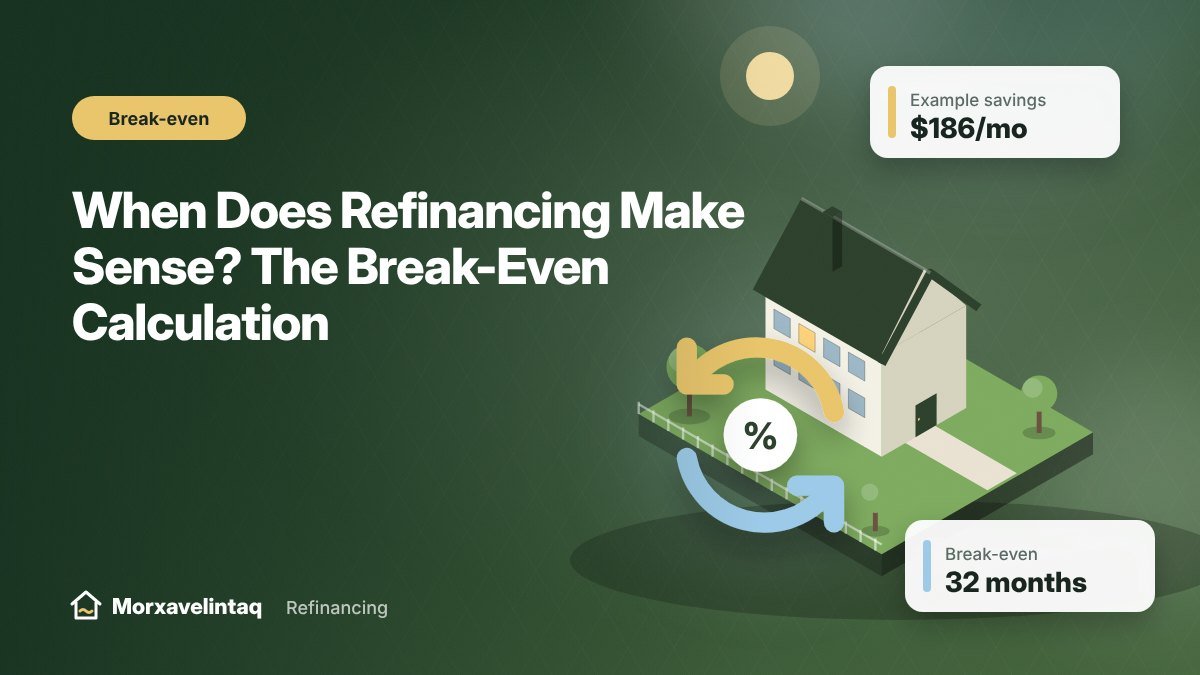
Example: you owe $280,000 at 7.25% and can refinance into a new 30-year loan at 6.25% with $6,000 in closing costs.
- Current principal and interest: $1,910
- New principal and interest: $1,724
- Monthly savings: $186
- Break-even: $6,000 ÷ $186 = about 32 months
If you'll stay in the home and keep the loan longer than about two and a half years, the refinance saves money.
The term-reset problem
The simple formula compares monthly payments, but it ignores time. If you're five years into a 30-year mortgage and refinance into a new 30-year loan, you've added five years of payments. Even with a lower rate, you might pay more total interest over the life of the loan.
Two ways to handle this:
- Match your remaining term. Ask for a 25-year loan instead of 30, or pay the old payment amount on the new loan to stay on schedule.
- Compare total interest over the period you expect to keep the loan, not just the monthly payment.
Is the 1% rule still useful?
The old rule says refinance when you can lower your rate by at least one percentage point. It's a reasonable starting point, but the break-even calculation is better. On a large loan with low closing costs, even a half-point drop can pay off quickly. On a small loan, a full point might not be worth it.
Other reasons to refinance
- Remove mortgage insurance by moving from FHA to conventional once you have 20% equity.
- Shorten your term, for example 30 years to 15 years, to save interest. See 15-year vs. 30-year mortgages.
- Switch from an ARM to a fixed rate before an adjustment.
- Take cash out for renovations or high-interest debt. Compare options in cash-out refinance vs. HELOC.
- Remove a borrower after a divorce.
Costs to include in your calculation
| Cost | Typical range |
|---|---|
| Origination and lender fees | 0.5%–1% of loan, varies widely |
| Appraisal | $500–$800 (sometimes waived) |
| Title insurance and settlement | Varies by state |
| Recording fees and taxes | Varies by county and state |
| Discount points (optional) | 1% of loan per point |
Prepaid interest and the new escrow account aren't really costs; they're payments you'd make anyway, and your old escrow balance is refunded after payoff.
Questions to ask before you refinance
- How long do I realistically expect to stay in this home?
- Will I reset to a longer term, and does that matter for my goals?
- Does my current loan have a prepayment penalty? (Most don't.)
- Has my credit or home value changed in a way that helps or hurts pricing?
- Would a streamline program, like an FHA Streamline or VA IRRRL, reduce costs?
A more complete break-even: comparing interest, not just payments
For a sharper answer, compare how much interest you'd pay under each loan over the time you expect to keep it. Using the example above, suppose you're three years into your current loan and expect to stay five more years. Add up the interest you'd pay on the current loan over the next 60 months, then add up the interest on the new loan over its first 60 months plus the $6,000 in closing costs. Whichever total is lower is the cheaper path. Lenders and many online amortization calculators can produce these schedules. This method captures the term-reset effect the simple formula misses.
Timing your refinance
No one can reliably predict rates, so trying to catch the exact bottom often backfires. A practical approach: decide in advance what rate would make a refinance worthwhile for you based on the break-even math, then ask a lender to alert you when rates reach that level. Have your documents ready, including recent pay stubs, W-2s, tax returns, bank statements, your homeowners insurance declaration page and your current mortgage statement, so you can lock quickly when the opportunity appears.
Frequently asked questions
How soon can I refinance after buying?
Rate-and-term refinances on conventional loans can sometimes happen almost immediately, though your current lender may have early payoff provisions with the investor. FHA and VA streamlines require about six months of payments, and cash-out refinances generally require at least 6 to 12 months of ownership.
Can I roll closing costs into the new loan?
Usually yes, if you have enough equity. That raises your balance, so include it in the break-even math.
Does refinancing hurt my credit?
There's a small, temporary dip from the inquiry and new account. It usually recovers within months with on-time payments.