Key takeaways
- The interest rate determines your monthly principal and interest payment.
- The annual percentage rate (APR) includes the interest rate plus certain fees, like points and origination charges, spread over the loan term.
- APR is useful for comparing loans with the same term and type, but it assumes you keep the loan for its full life.
- If you'll sell or refinance early, focus on upfront costs and break-even timing too.
Every mortgage ad shows two percentages, and the APR is always a little higher. That gap isn't a trick; it's a federally required way to show how much a loan costs once fees are included.
What the interest rate tells you
Your interest rate is the cost of borrowing the principal, expressed as an annual percentage. It's what's used to calculate your monthly principal and interest payment. Two loans with the same rate have the same principal and interest payment, even if one costs thousands more at closing.
What APR tells you
APR, required under the Truth in Lending Act, reflects the interest rate plus finance charges such as:
- Discount points
- Origination and underwriting fees
- Mortgage broker fees
- Prepaid interest
- Mortgage insurance premiums
Some costs are generally excluded, such as appraisal fees, credit report fees, title insurance and recording fees in many cases.
A worked example
Two lenders offer a $300,000, 30-year fixed loan:
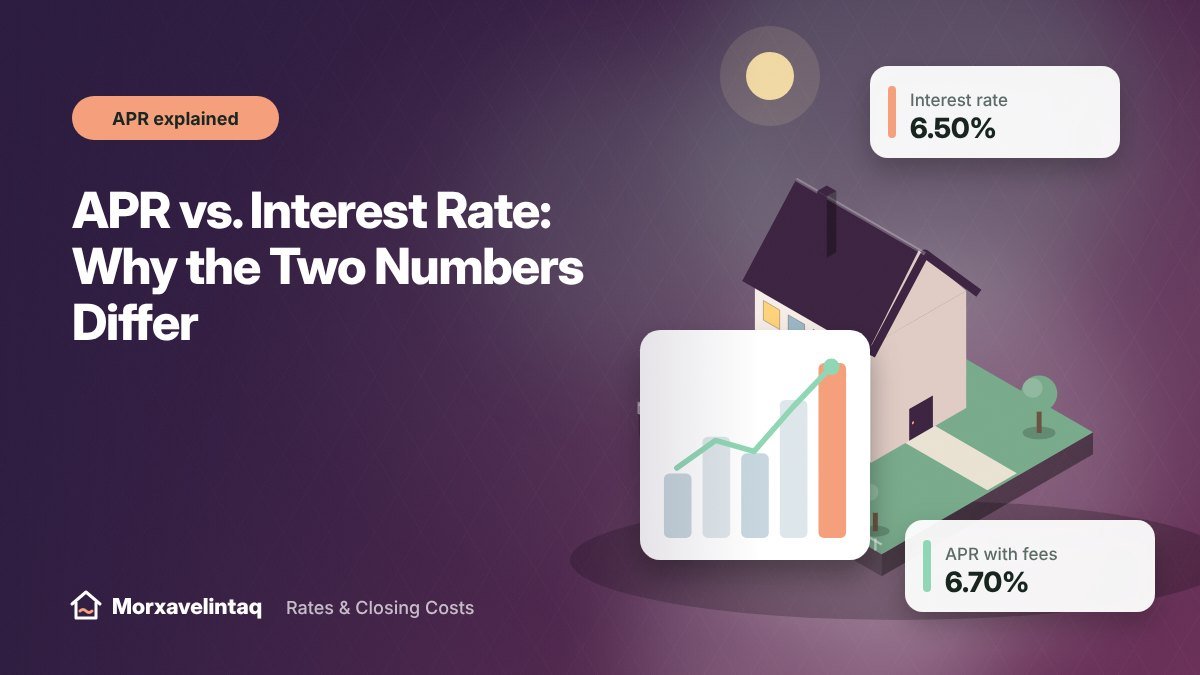
- Lender A: 6.50% rate, $6,000 in finance charges. APR: about 6.70%
- Lender B: 6.625% rate, $1,000 in finance charges. APR: about 6.66%
Lender A has the lower rate and the lower monthly payment, but Lender B has the lower APR because its fees are much smaller. If you'll keep the loan for decades, Lender A may still win. If you'll refinance in a few years, Lender B's lower upfront costs probably win.
Why APR assumes the full term
APR spreads upfront costs over the entire loan term, usually 30 years. Most borrowers sell or refinance well before then. The shorter your time horizon, the more upfront fees matter relative to the rate, and the less reliable APR becomes as a comparison tool.
APR on adjustable-rate mortgages
For ARMs, the APR calculation assumes the index stays at its current level after the fixed period. Because no one knows future rates, an ARM's APR is a rough guide at best. Look at the caps and worst-case payment instead. Our 5/6 ARM guide explains how.
How to use APR the smart way
- Compare APRs only between loans of the same type and term.
- Ask each lender for an official Loan Estimate on the same day for the same loan amount and lock period.
- Look at Section A (origination charges) and the points separately from the rate.
- Estimate how long you'll keep the loan and calculate the break-even point for any extra fees. See are mortgage points worth it.
Where to find APR on your documents
On the Loan Estimate, APR appears on page 3 under "Comparisons," along with the total interest percentage and what you'll have paid in the first five years. On the Closing Disclosure, it appears on page 5.
Common APR misunderstandings
- "APR is the rate I'll pay." No. Your payment is calculated from the note rate. APR is a disclosure tool that blends fees into a single number.
- "The lowest APR is always the cheapest loan." Only over the full term. For a shorter holding period, upfront costs matter more.
- "APR includes all closing costs." It includes finance charges, but many third-party costs, such as appraisal, title insurance and recording fees, are often excluded. Two loans can have identical APRs and very different cash-to-close amounts.
- "APR is fixed once I lock." APR can change if fees, points or the loan amount change before closing.
A simple two-number check
When comparing offers, write down two numbers for each: the monthly principal and interest payment, and the total lender-controlled upfront cost (points plus Section A fees, minus lender credits). Then ask: how many months does it take for the lower payment to pay back the higher upfront cost? If that break-even point is shorter than how long you'll keep the loan, the lower-rate option is the better deal. APR gives you a quick sanity check, but this two-number comparison reflects your actual plans.
Frequently asked questions
Is a lower APR always better?
Not always. It's better if you keep the loan for many years. If you'll refinance soon, a loan with lower upfront costs can cost less even with a higher APR.
Why did my APR change between the Loan Estimate and Closing Disclosure?
Changes in fees, points, or the rate lock can change APR. Increases beyond a set threshold trigger a new three-business-day review.
Do no-closing-cost loans have a higher APR?
Often the rate is higher but the APR may be close, since fees are lower. Learn more in our no-closing-cost refinance guide.