Key takeaways
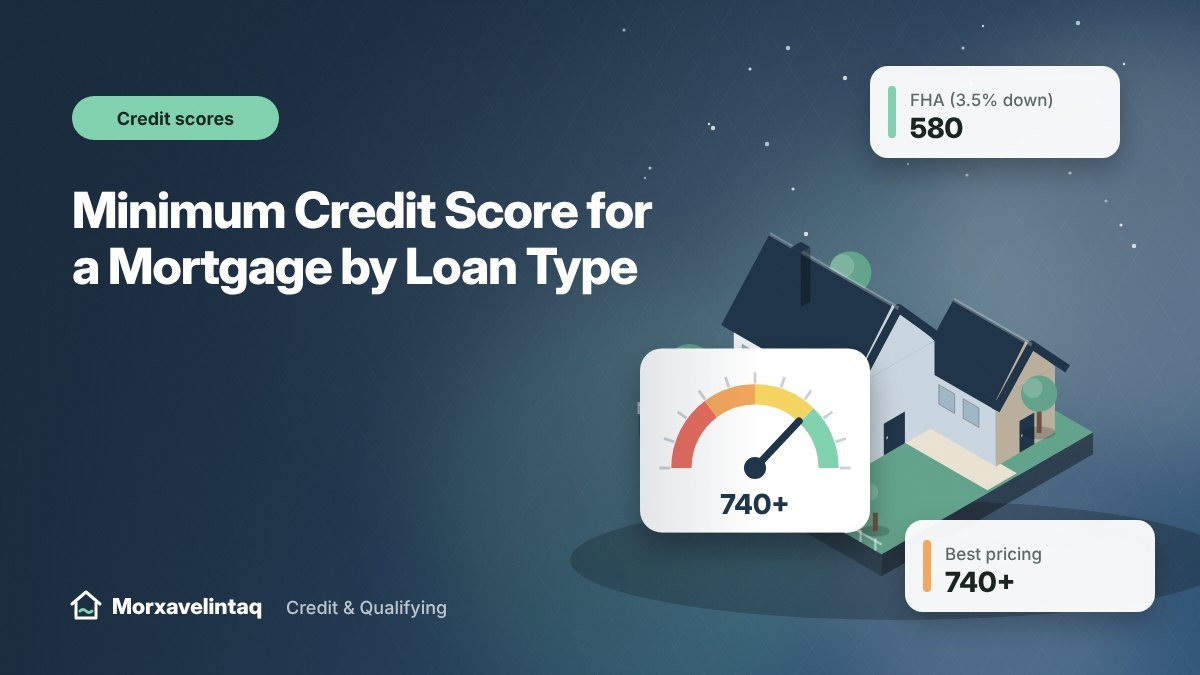
- FHA allows scores as low as 580 with 3.5% down, or 500 to 579 with 10% down.
- VA and USDA don't set strict program minimums, but most lenders look for 580 to 640.
- Conventional loans have commonly required 620, though Fannie Mae removed its hard minimum for loans approved through Desktop Underwriter in late 2025; most lenders still apply a floor.
- Your score affects your rate and mortgage insurance cost well above the minimum. The best pricing usually starts around 740 to 780.
"What credit score do I need to buy a house?" depends on the loan program and the lender. Programs set their own rules, and lenders can add stricter requirements called overlays. Here's a realistic picture of where the bar sits for each type of loan.
Typical minimum scores by loan type
| Loan type | Program minimum | What many lenders require |
|---|---|---|
| FHA (3.5% down) | 580 | 580–620 |
| FHA (10% down) | 500 | Few lenders go this low |
| VA | No VA-set minimum | 580–620 |
| USDA | No hard minimum; 640 for automated approval | 620–640 |
| Conventional | No hard minimum in Fannie Mae's DU since late 2025; 620 traditionally | 620 is still common |
| Jumbo | Set by lender | 680–720+ |
Program rules change. Confirm current requirements with lenders, and ask whether a quoted minimum is the program's rule or the lender's overlay.
Which score do lenders use?
Mortgage lenders pull a tri-merge report with scores from Equifax, Experian and TransUnion. They typically use your middle score. With two borrowers, many lenders use the lower of the two middle scores, though some programs now average scores. Mortgage lenders have historically used older FICO versions, and the industry is transitioning to newer models like FICO 10 T and VantageScore 4.0, so your mortgage score may differ from the one in your banking app.
How your score affects cost, not just approval
Conventional loans use loan-level price adjustments based on your score and down payment. PMI premiums also drop as scores rise. Moving from 660 to 740 can lower both your rate and PMI meaningfully, often worth more than $100 a month on a typical loan. FHA pricing varies less by score, which is why FHA often wins for borrowers below about 680. See our FHA vs. conventional comparison.
What matters besides the score
- Debt-to-income ratio. See our DTI guide.
- Recent late payments, especially on rent or housing.
- Collections and judgments, which may need to be paid or explained.
- Bankruptcy or foreclosure history and required waiting periods.
- Cash reserves, which can offset a lower score.
Can you buy a home with no credit score?
Some programs allow nontraditional credit, using rent, utility, insurance and phone payment history. FHA and some conventional programs permit this with manual underwriting. Expect more documentation and stricter debt ratio limits.
How to improve your score before applying
- Pay credit card balances down to below 30% of your limits; below 10% is even better.
- Check all three reports and dispute errors.
- Don't close old accounts.
- Make every payment on time; set up autopay.
- Ask a lender about a rapid rescore once balances are paid down.
Lender overlays explained
An overlay is a lender's own requirement that's stricter than the loan program's rules. A lender might require a 620 score for FHA loans even though FHA allows 580, or require extra reserves for borrowers below a certain score. Overlays exist because lenders carry risk if loans perform poorly, and government agencies evaluate lenders partly on their default rates. If one lender turns you down for a score that's above the program minimum, ask whether it's an overlay. Another lender, often a smaller mortgage company or credit union, may have fewer overlays and be able to approve the same file.
How much a higher score can save
Pricing differences between credit tiers can be large. On a conventional loan with 5% down, a borrower with a 680 score may pay a noticeably higher rate and nearly double the PMI premium of a borrower with a 760 score. On a $300,000 loan, the combined difference can easily exceed $100 to $150 a month. Over the first five years, that's $6,000 to $9,000, more than enough to justify a few months of credit improvement before applying if your timeline allows.
Building credit if you're starting from scratch
If you have few or no accounts, start with a secured credit card or a credit-builder loan from a credit union. Use the card for a small recurring bill, pay it in full every month, and keep the account open. Ask your landlord or a rent-reporting service to report on-time rent payments. Within 6 to 12 months of on-time history, most people have a usable score, and many reach mortgage-ready levels within a year or two.
Frequently asked questions
Can I get a mortgage with a 550 credit score?
Possibly with an FHA loan and 10% down, but few lenders offer it. Improving to 580 opens far more options.
Is 620 a good credit score for a mortgage?
It meets many lenders' minimums, but pricing at 620 is significantly higher than at 700 or 740.
How long does it take to improve my score?
Paying down credit cards can raise scores within one or two billing cycles. Recovering from late payments takes longer.