Key takeaways
- Student loans count in your debt-to-income ratio, even if they're deferred or in forbearance, under most programs.
- Each loan program calculates the payment differently when your reported payment is $0 or the loan is deferred.
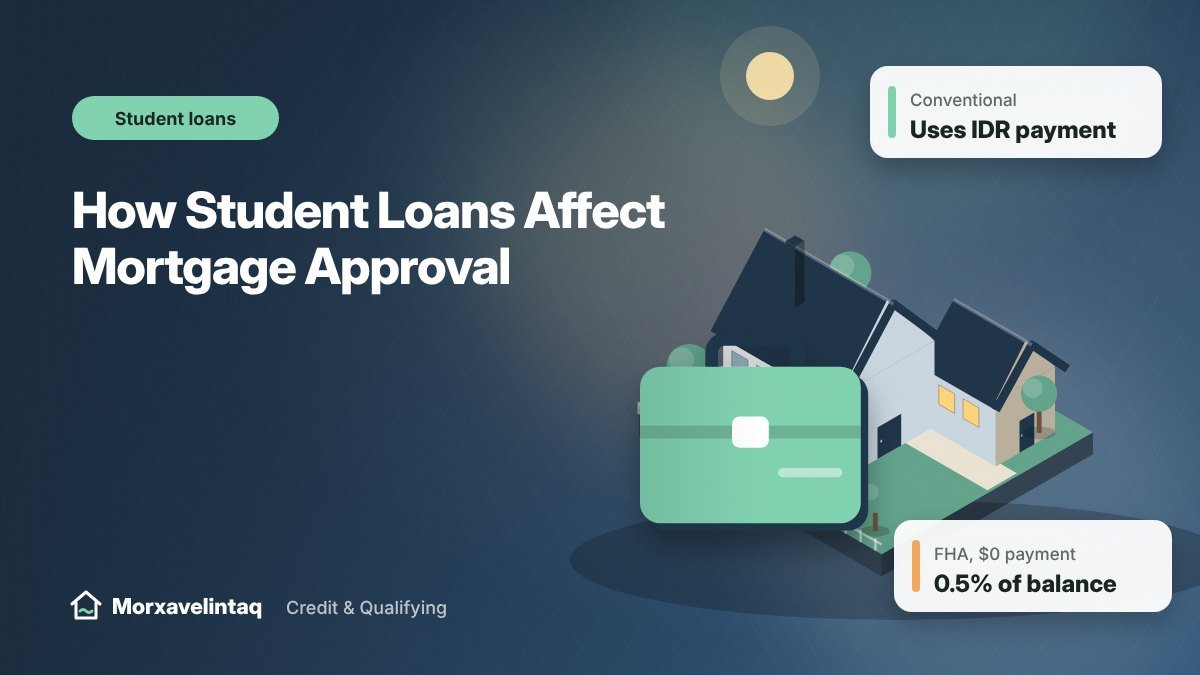
- Conventional loans through Fannie Mae can accept a documented $0 income-driven repayment payment.
- Choosing the right program can raise your buying power by thousands of dollars.
About 43 million Americans carry federal student loans, and many worry their balance will block homeownership. In most cases, what matters is the monthly payment lenders count, not the total balance. The rules differ by loan program, so this is one area where shopping loan types really pays.
How each program counts student loan payments
| Loan type | If a payment is reported | If the payment is $0 or deferred |
|---|---|---|
| Conventional (Fannie Mae) | Use the reported payment, including income-driven payments | A documented $0 IDR payment can be used; otherwise 1% of the balance or a calculated amortizing payment |
| Conventional (Freddie Mac) | Use the reported payment | 0.5% of the outstanding balance |
| FHA | Use the reported payment if greater than $0 | 0.5% of the outstanding balance |
| VA | Use the reported payment if it's at least the threshold below | 5% of the balance divided by 12, unless deferred at least 12 months past closing, in which case it can be excluded |
| USDA | Use the reported payment if greater than $0 | 0.5% of the outstanding balance |
Program rules change periodically. Ask lenders how they're currently calculating your specific loans.
Why the method matters: an example
A borrower has $80,000 in federal student loans on an income-driven plan with a documented $0 monthly payment.
- Fannie Mae conventional: $0 can be counted. No student loan payment in DTI.
- FHA or Freddie Mac: 0.5% × $80,000 = $400 a month counted.
- VA (not deferred 12+ months): 5% × $80,000 ÷ 12 = $333 a month counted.
On a $6,000 gross monthly income, that $400 difference represents nearly 7 percentage points of DTI and could change the affordable home price by $50,000 or more.
Tips for borrowers with student loans
- Enroll in an income-driven plan well before applying if you're eligible, and make sure the new payment shows on your credit report or in your servicer documentation.
- Get a payment letter from your servicer showing your current monthly payment.
- Stay current. Federal student loans in default can disqualify you from FHA, VA and USDA loans, which check the federal CAIVRS database.
- Ask lenders to run multiple programs. A good loan officer will compare conventional and FHA treatment for your loans.
- Consider paying off a small loan if it significantly lowers DTI.
What about Public Service Loan Forgiveness?
Expected forgiveness doesn't remove the debt from your DTI calculation until it actually happens. Lenders count the payment based on the rules above.
Private student loans
Private loans generally follow the same calculations, using the reported payment, or the program's percentage rule if the loan is deferred. Private loans don't have income-driven plans, so payments are often higher.
For a broader look at DTI, see our debt-to-income ratio guide.
Documents to gather
- A current statement from each student loan servicer showing the balance and monthly payment
- If you're on an income-driven plan, documentation of the plan and the current payment amount, including $0 payments
- If your loans are deferred or in forbearance, a letter showing the status and the date it ends
- Proof of any loans paid off recently, if they still appear on your credit report
Credit reports sometimes show outdated payment amounts, especially after you switch repayment plans. Providing a current servicer statement lets the lender use the accurate figure rather than a higher calculated payment.
Should you consolidate or refinance student loans before buying?
Changing your student loans shortly before a mortgage application can help or hurt. Consolidating federal loans into a Direct Consolidation Loan can make you eligible for certain repayment plans and simplify documentation, but it may reset progress toward forgiveness. Refinancing federal loans into a private loan might lower your rate, but you lose income-driven repayment options and federal protections, and a higher fixed payment could raise your debt-to-income ratio. Talk to your loan officer about how each scenario would be counted before making a change, and avoid any move that creates a new hard inquiry or new account during the mortgage process.
Frequently asked questions
Can I get a mortgage with student loans in default?
It's difficult. Government-backed loans generally require you to resolve federal defaults first, often through rehabilitation or consolidation.
Do lenders care about my total student loan balance?
Mainly the payment. However, when payments are $0 or deferred, some programs use a percentage of the balance.
Should I pay off student loans before buying?
Not always. Keeping cash for a down payment and reserves may help more, especially if your loan payment is low. Run both scenarios with a lender.