Key takeaways
- Lenders review two years of work history, but you don't need two years at the same employer.
- Moving to a new salaried job in the same field, at the same or higher pay, is usually fine.
- Some programs accept a signed offer letter for a job starting shortly after closing.
- Commission, bonus, hourly and self-employment income have stricter history requirements.
Starting a new job and buying a home often happen at the same time, especially when people relocate. The good news: a job change doesn't automatically block a mortgage. The details of the change matter far more than the timing.
The two-year history rule, explained
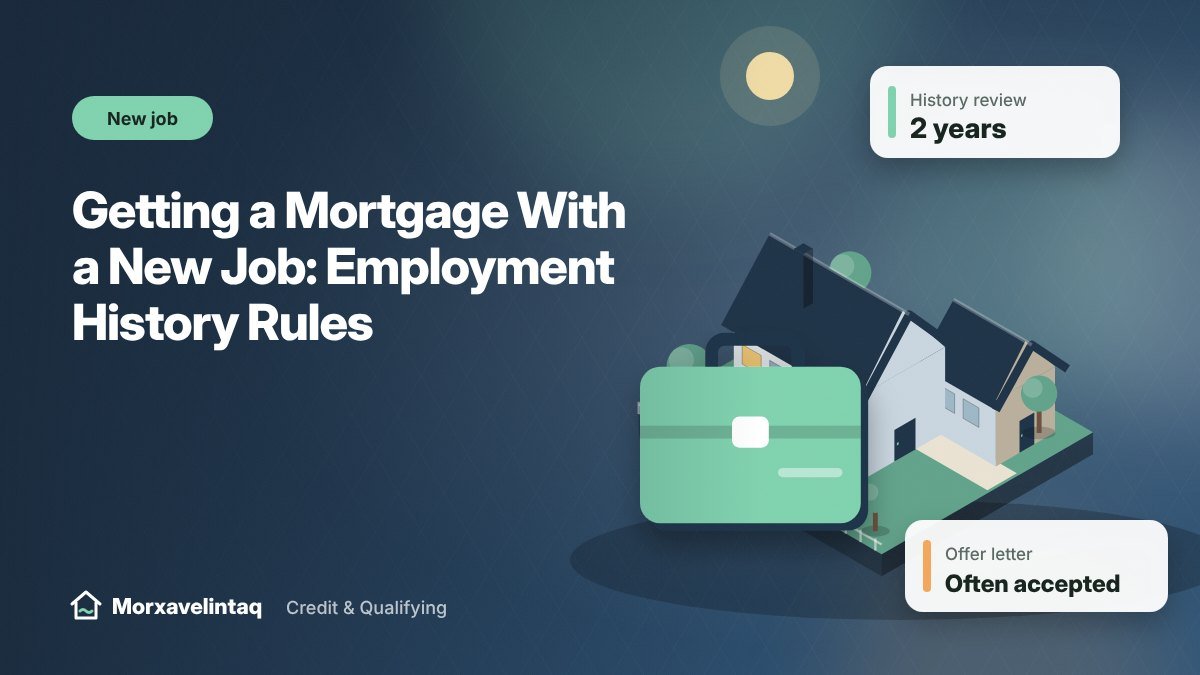
Lenders look for a two-year employment history to judge stability. That doesn't mean two years at one company. Job changes are fine as long as your income is stable or rising. School or military training related to your current job can count toward the two years.
Job changes lenders generally accept
- A new salaried job in the same line of work with equal or higher base pay
- A promotion with your current employer
- A move from hourly to salary at similar or higher pay
- Recent graduates starting their first job in their field, with transcripts or a diploma
Changes that create challenges
| Situation | Why it's harder |
|---|---|
| Switching from salary to commission | Commission usually needs a 12- to 24-month history before it counts |
| Moving to a new field | Lenders may question stability without a track record |
| Becoming self-employed | Generally requires two years of tax returns, sometimes one with prior industry experience |
| Starting a probationary period | Some lenders want to know if continued employment is uncertain |
| Taking a pay cut or going part-time | Lower qualifying income |
Closing on an offer letter
Fannie Mae and Freddie Mac allow borrowers to qualify using a non-contingent job offer with a start date shortly after closing, generally within 90 days, if certain conditions are met, such as extra reserves or a paystub before closing. FHA and VA have their own rules for future employment. Not every lender participates, so ask early.
Gaps in employment
Gaps of more than a month or two often require a letter of explanation. Longer gaps, around six months or more, may require you to be back at work for a set period, often six months, before income can count, depending on the program. Gaps for school, caregiving or medical reasons are reviewed with documentation.
What to provide your lender
- Signed offer letter showing salary, start date and position
- Your first paystub as soon as you receive it
- W-2s from previous employers for the past two years
- Contact information for HR so the lender can verify employment
- A brief explanation of any gaps
Example: a nurse moves from a hospital in Ohio to a higher-paying hospital job in North Carolina and wants to buy right away. She provides her offer letter, her two previous W-2s and her first paystub. Because she's in the same field earning more, the lender qualifies her using the new salary.
Don't change jobs mid-process without calling
Lenders typically verify employment again within a few days of closing. A surprise job change during underwriting can delay or derail your loan. Read more in what not to do after applying for a mortgage.
Relocating for work: timing your purchase
If you're moving for a new job, you have two main options. You can buy before you start, using a qualifying offer letter, which lets you move straight into your new home but requires a lender that accepts future-employment income and often extra reserves. Or you can rent briefly, start the job, and buy once you have a paystub, which simplifies underwriting and gives you time to learn neighborhoods. Some employers offer relocation packages that cover closing costs or temporary housing; documentation of relocation benefits can strengthen your file. Talk with a lender before you sign a lease so you know which path fits your timeline.
Recent graduates and first jobs
If you just finished school, lenders can often count your education toward the two-year history, especially when your job is in your field of study. Provide your diploma or final transcript along with your offer letter and first paystub. Many new graduates qualify quickly when their salary is stable, though student loan payments will be part of the debt-to-income calculation.
Frequently asked questions
Can I get a mortgage one month into a new job?
Often yes, if it's salaried in the same field with comparable pay. Expect to provide your offer letter and first paystub.
Do bonuses from a new job count?
Usually not until you have a history of receiving them, typically one to two years.
What about contract or gig work?
Contract and 1099 income typically needs a two-year history, documented through tax returns.