Key takeaways
- FHA loans often have lower rates for borrowers with mid-range credit, but they charge a 1.75% upfront premium and annual mortgage insurance that can last for the life of the loan.
- Conventional loans charge private mortgage insurance (PMI) priced by credit score, and PMI can be removed once you reach 20% equity.
- With credit scores in the 620s and 600s, FHA frequently wins. With scores of 740 and up, conventional usually wins.
- Compare real Loan Estimates for both, not just advertised rates.
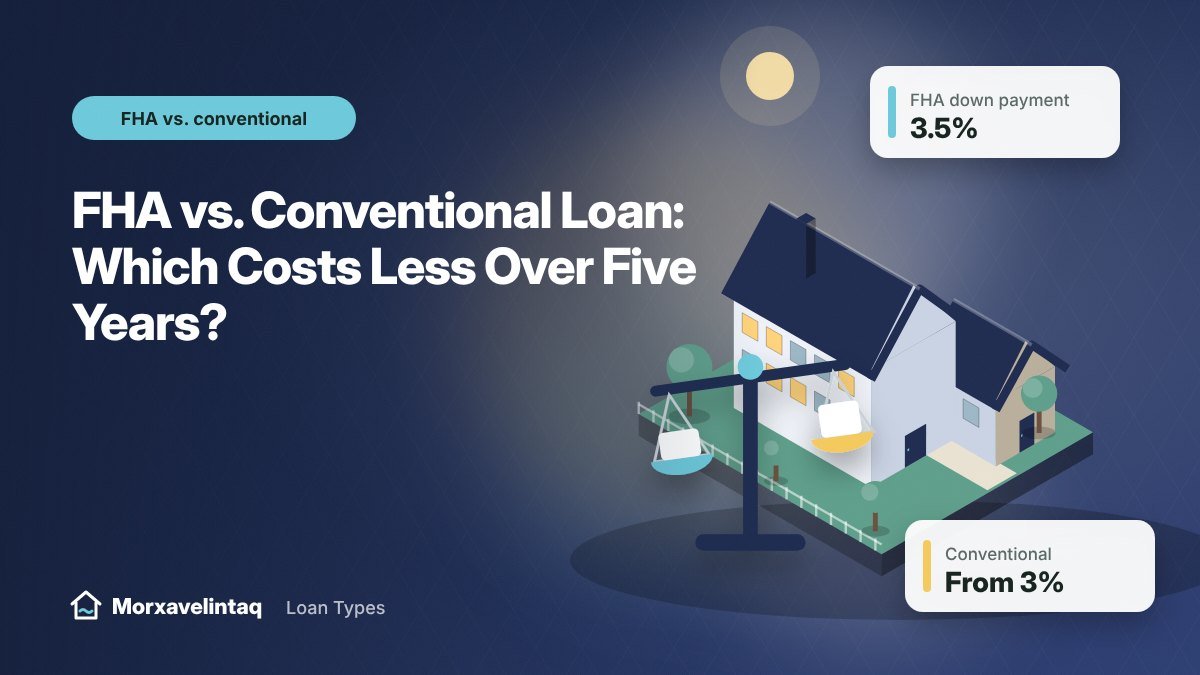
For buyers with a small down payment, the choice usually comes down to FHA or conventional. Both can work with 3% to 3.5% down, but they price risk differently. FHA uses one set of mortgage insurance rules for nearly everyone, while conventional PMI rewards higher credit scores. Here's a side-by-side look at what each costs over the first five years, when most homeowners either sell or refinance.
The basic differences
| FHA | Conventional | |
|---|---|---|
| Minimum down payment | 3.5% with a 580+ score; 10% with 500–579 | 3% for eligible buyers (often first-time or income-limited programs); 5% otherwise |
| Credit flexibility | Very flexible | Best pricing for higher scores |
| Upfront mortgage insurance | 1.75% of the base loan, usually financed | None |
| Monthly mortgage insurance | 0.55% per year for most borrowers | Varies by credit score and down payment |
| Insurance removal | Life of loan if under 10% down; 11 years with 10%+ down | Can be canceled at 80% loan-to-value; ends automatically at 78% |
| 2026 loan limit (one unit) | $541,287 in most areas, higher in high-cost counties | $832,750 baseline, higher in high-cost counties |
Five-year cost example on a $300,000 home
These scenarios use illustrative rates and insurance costs. Your actual pricing will differ.
- FHA: 3.5% down, 6.25% rate, 1.75% upfront premium financed, 0.55% annual MIP. Loan amount: about $294,600.
- Conventional, 700 credit score: 5% down, 6.75% rate, PMI around 0.55% per year. Loan amount: $285,000.
- Conventional, 760 credit score: 5% down, 6.5% rate, PMI around 0.3% per year. Loan amount: $285,000.
| FHA | Conv. (700 score) | Conv. (760 score) | |
|---|---|---|---|
| Principal and interest | $1,814 | $1,849 | $1,801 |
| Mortgage insurance | $133 | $131 | $71 |
| Monthly total (before taxes and insurance) | $1,947 | $1,980 | $1,872 |
| Paid over 5 years | $116,800 | $118,700 | $112,400 |
| Loan balance after 5 years | $274,900 | $267,500 | $266,800 |
Notice the balance row. Because the FHA upfront premium is added to the loan, the FHA borrower owes about $7,000 more after five years than the conventional borrower with the same home. Payments look close for the 700-score buyer, but the conventional loan builds equity faster and its PMI can eventually be removed. For the 760-score buyer, conventional wins clearly.
When FHA is usually the better deal
- Your credit score is below about 680, where conventional PMI and rate adjustments get expensive.
- Your debt-to-income ratio is high and needs FHA's more flexible underwriting.
- You've had a recent bankruptcy or foreclosure; FHA waiting periods are shorter. See buying a home after bankruptcy.
- You want an assumable loan that a future buyer could take over.
When conventional is usually the better deal
- Your score is 720 or higher.
- You expect your home to appreciate and want to drop PMI quickly. Our guide on removing PMI explains how.
- You're buying above FHA's county limit.
- You're buying a second home or investment property, which FHA doesn't finance.
The refinance factor
Many FHA borrowers plan to refinance into a conventional loan once they reach 20% equity to drop mortgage insurance. That strategy works, but it depends on future rates and adds closing costs. If you're choosing FHA now, look at the FHA Streamline Refinance as another future option.
How to run your own comparison
The table above uses illustrative numbers. To compare your real options, ask a lender to quote both loans for the same price and down payment on the same day, then line up these figures:
- Interest rate and any discount points for each loan.
- Monthly mortgage insurance: FHA's annual MIP divided by 12, and the conventional PMI quote based on your actual credit score.
- Upfront costs: FHA's 1.75% premium (usually financed) versus any conventional fees.
- Projected balance after five years, which shows the effect of the financed upfront premium.
- When mortgage insurance ends under each loan, assuming modest appreciation.
Then add up five years of payments and subtract the five-year balance difference. The loan with the lower combined cost is usually the better deal for you, unless you value FHA's flexibility on debt ratios or credit history.
Frequently asked questions
Is FHA only for first-time buyers?
No. Any buyer who will live in the home as a primary residence can use FHA, as long as they meet the program requirements.
Are FHA rates always lower?
Advertised FHA rates are often lower, but once mortgage insurance and the upfront premium are included, the overall cost can be higher, especially for borrowers with strong credit.
Can I switch from FHA to conventional later?
Yes, by refinancing. You'll need to qualify for the new loan and pay closing costs.