Key takeaways
- The VA funding fee is a one-time charge that helps fund the VA home loan program, which requires no down payment and no monthly mortgage insurance.
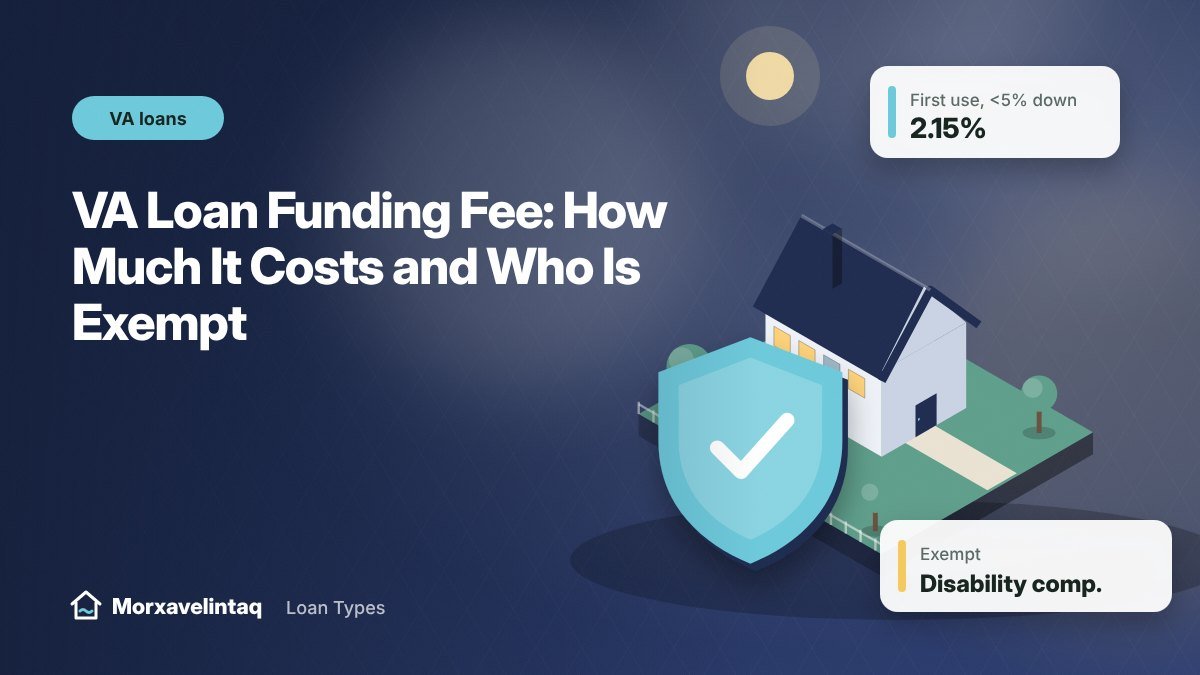
- For a first-time purchase with less than 5% down, the fee is 2.15% of the loan amount.
- Veterans receiving VA disability compensation, eligible surviving spouses, and some active-duty Purple Heart recipients are exempt.
- You can pay the fee in cash or add it to your loan.
VA loans are one of the best mortgage benefits available: zero down payment, no monthly mortgage insurance and competitive rates. The trade-off is the funding fee, an upfront charge paid to the Department of Veterans Affairs. Knowing the exact percentage and whether you're exempt can save you thousands.
Current VA funding fee rates for purchases
| Down payment | First use | Subsequent use |
|---|---|---|
| Less than 5% | 2.15% | 3.30% |
| 5% to less than 10% | 1.50% | 1.50% |
| 10% or more | 1.25% | 1.25% |
Funding fees for other VA loan types
| Loan type | Fee |
|---|---|
| Interest Rate Reduction Refinance Loan (IRRRL) | 0.50% |
| Cash-out refinance, first use | 2.15% |
| Cash-out refinance, subsequent use | 3.30% |
| Loan assumption | 0.50% |
| Manufactured home (not permanently affixed) | 1.00% |
The VA updates these rates periodically. Confirm the current figures on the VA's website or with your lender before closing.
Who is exempt from the VA funding fee?
You generally don't pay the funding fee if any of the following apply:
- You receive VA compensation for a service-connected disability.
- You're eligible for VA disability compensation but receive retirement or active-duty pay instead.
- You're rated eligible for compensation as a result of a pre-discharge exam or review.
- You're a service member on active duty who has received the Purple Heart, with proof provided at or before closing.
- You're the surviving spouse of a veteran who died in service or from a service-connected disability and you receive Dependency and Indemnity Compensation.
Your exemption status appears on your Certificate of Eligibility (COE). If you have a pending disability claim, tell your lender. If you're later awarded compensation with an effective date before closing, you may be able to request a refund of the fee from the VA.
Example: what the fee costs
A first-time VA borrower buys a $350,000 home with no down payment. The funding fee is 2.15% × $350,000 = $7,525. If financed, the loan becomes $357,525. At a 6.25% rate over 30 years, financing the fee adds about $46 to the monthly payment. If the same borrower puts 5% down, the fee drops to 1.5% of $332,500, or $4,988, and the loan is smaller too.
Should you finance the fee or pay cash?
- Financing preserves your cash for moving costs and emergencies, which is why most borrowers choose it.
- Paying cash saves the interest you'd pay on the fee over the life of the loan and keeps your balance lower.
- Seller concessions can also cover the funding fee. VA limits concessions to 4% of the loan amount, and paying the funding fee counts toward that cap.
How the funding fee compares to mortgage insurance
FHA borrowers pay a 1.75% upfront premium plus annual mortgage insurance, often for the life of the loan. Conventional borrowers with less than 20% down pay monthly PMI. The VA funding fee is a one-time cost with no ongoing insurance, which usually makes VA the least expensive option for eligible borrowers over time. Compare options in our guide to FHA vs. conventional loans.
Checking your exemption before closing
Your exemption status should appear on your Certificate of Eligibility, which your lender can pull electronically through the VA portal. Review it as soon as your lender orders it. If you receive VA disability compensation but your COE doesn't show an exemption, contact your lender and the VA right away; correcting it before closing is far simpler than requesting a refund afterward. If you have a disability claim pending, tell your lender at application so they can document it and watch for an award before closing. Surviving spouses should provide documentation of Dependency and Indemnity Compensation.
Combining VA benefits with other help
Veterans can often pair a VA loan with state veteran programs, down payment assistance, or property tax exemptions for veterans and disabled veterans. Some states offer reduced-rate loans for veterans through their housing finance agencies. Ask your lender and your state veterans affairs office what's available where you're buying.
Frequently asked questions
Is the VA funding fee refundable?
Generally no, except when a veteran is later found to be exempt with a disability award effective before the closing date.
Do National Guard and Reserve members pay a different fee?
Under current rules, Guard and Reserve members pay the same rates as regular military borrowers.
Does the funding fee apply to a VA IRRRL?
Yes, at 0.5%, unless you're exempt. Learn more in our VA IRRRL guide.