Key takeaways
- A jumbo loan is any mortgage larger than the conforming loan limit set each year by the Federal Housing Finance Agency.
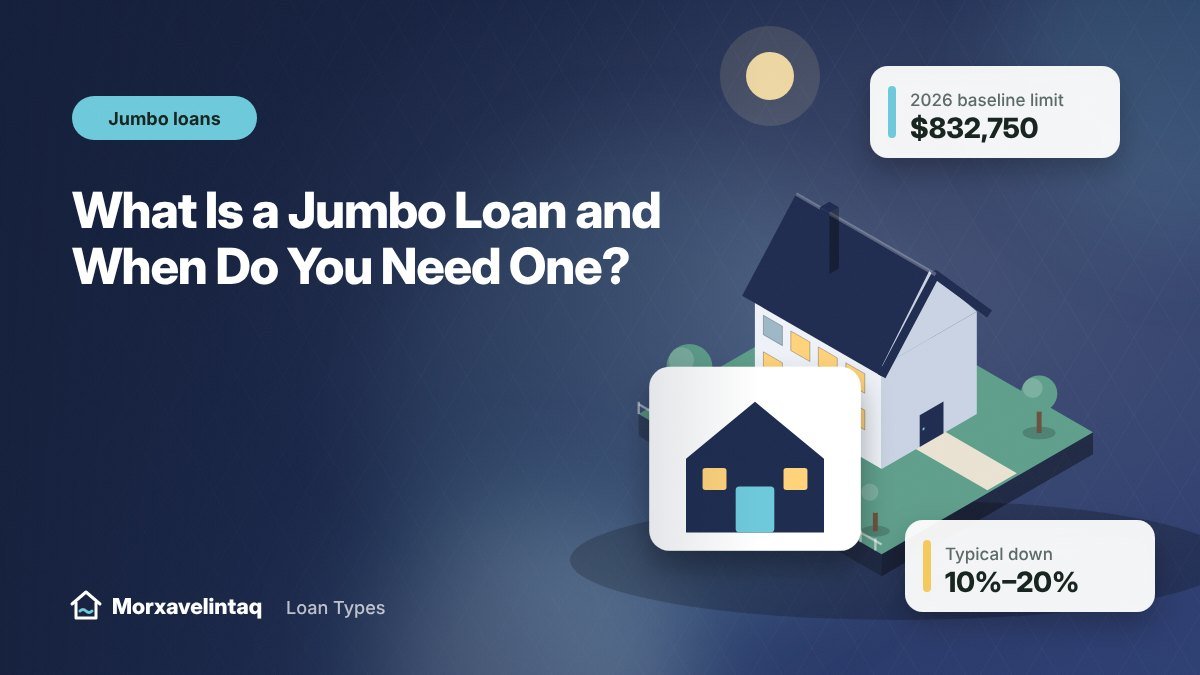
- For 2026, the baseline limit for a one-unit home is $832,750 in most of the country, with higher limits in designated high-cost areas.
- Jumbo loans typically require stronger credit, lower debt ratios, larger down payments and more cash reserves.
- Jumbo rates aren't always higher than conforming rates; it depends on the lender and market.
When a home's price pushes your loan above the conforming limit, Fannie Mae and Freddie Mac can't buy it. Lenders either keep these loans on their own books or sell them to private investors, so they set their own rules. That's what makes a loan "jumbo."
2026 conforming loan limits
The FHFA raised the baseline conforming limit for one-unit homes to $832,750 for 2026. In high-cost areas, the ceiling is 150% of the baseline, or $1,249,125. Limits for two- to four-unit properties are higher. Because limits are set by county, check the FHFA's county list for the exact figure where you're buying.
Typical jumbo loan requirements
| Requirement | Conforming loan | Typical jumbo loan |
|---|---|---|
| Minimum credit score | Set by automated underwriting and lender rules | Often 700 to 720+ |
| Down payment | As little as 3% | Often 10% to 20% |
| Debt-to-income ratio | Up to 50% with strong files | Often 43% or lower |
| Cash reserves | Sometimes none required | Often 6 to 12 months of payments |
| Appraisal | One appraisal, sometimes waived | Full appraisal; sometimes two for very large loans |
Are jumbo rates higher?
Not necessarily. Because jumbo borrowers tend to have strong finances and banks want those relationships, jumbo rates are sometimes equal to or even below conforming rates. Banks may offer relationship discounts if you move assets to them. Compare offers from banks, credit unions and mortgage lenders.
Alternatives to a jumbo loan
- Larger down payment: bringing your loan under the conforming limit unlocks more lenders and simpler underwriting.
- Piggyback loan: a conforming first mortgage at the limit plus a second mortgage or HELOC for the remainder, sometimes called an 80-10-10 structure.
- High-balance conforming loan: in high-cost counties, loans above the baseline but below the county limit are still conforming.
- VA loans: veterans with full entitlement have no VA loan limit, though lenders may set their own caps.
Example: a buyer purchasing a $1,000,000 home in a county with the $832,750 baseline limit puts 15% down, needing a $850,000 loan, just $17,250 over the limit. By increasing the down payment to about 16.8%, the loan drops to $832,000 and qualifies as conforming. Alternatively, a piggyback structure could keep the first mortgage under the limit.
Documentation to expect
- Two years of tax returns, even for salaried borrowers at some lenders
- Several months of statements for all asset accounts
- Detailed explanations of large deposits and business income
- Proof of reserves, which can include retirement accounts at a discounted value
How to prepare for a jumbo application
Because jumbo lenders set their own rules and review files manually more often, preparation pays off. Start gathering documents a month or two before you shop: two years of tax returns with all schedules, two months of statements for every asset account (including retirement and brokerage), recent pay stubs, and documentation for any business you own. Avoid moving money between accounts in the months before you apply, since each large transfer will need to be explained.
Reserves deserve special attention. If a lender requires 12 months of reserves on a $7,000 monthly payment, you'll need $84,000 left after closing. Retirement accounts often count at a discounted value, such as 60% to 70% of the vested balance, to account for taxes and penalties. Confirm how each lender counts your assets before you decide how much to put down; sometimes a slightly smaller down payment keeps enough in reserve to qualify for better terms.
Jumbo appraisals and unique homes
Higher-priced homes often have fewer comparable sales, which makes appraisals harder. Custom homes, large acreage and luxury features can lead to appraisal gaps. If you're competing in a high-end market, discuss an appraisal contingency strategy with your agent, and ask your lender whether a second appraisal will be required for your loan size.
Frequently asked questions
Can I get a jumbo loan with 10% down?
Yes, many lenders offer 10% down jumbo options for borrowers with strong credit and reserves. Some offer even lower down payments with stricter requirements.
Do jumbo loans have PMI?
Many jumbo programs with less than 20% down don't use traditional PMI; instead, the lender prices the risk into the rate. Ask how your lender handles it.
Do conforming limits change every year?
They're reviewed annually and usually announced in late November for the following year, based on home price changes.