Key takeaways
- A hard mortgage inquiry may lower your score by a few points temporarily.
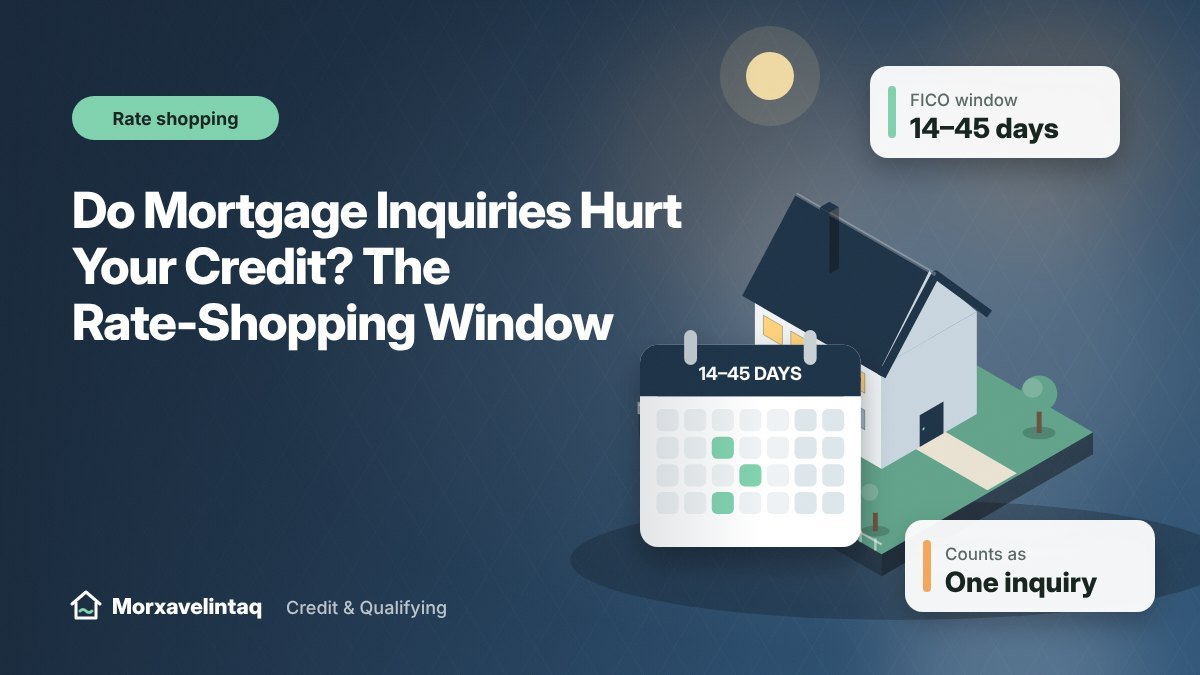
- Scoring models group multiple mortgage inquiries within a shopping window and count them as one.
- Newer FICO versions use a 45-day window; older versions used by many mortgage lenders use 14 days.
- Keep your shopping within two weeks to be safe across all models.
Many buyers avoid getting multiple quotes because they fear the credit hit. That's a costly mistake. The Consumer Financial Protection Bureau encourages shopping, and credit scoring models are designed to allow it.
Hard vs. soft inquiries
- Soft inquiry: doesn't affect your score. Used for pre-qualification by some lenders, checking your own credit, and prescreened offers.
- Hard inquiry: appears on your report and can affect your score. Used for pre-approval and full applications.
How the rate-shopping window works
| Scoring model | Shopping window |
|---|---|
| Older FICO versions (common in mortgage lending) | 14 days |
| Newer FICO versions | 45 days |
| VantageScore | 14 days |
FICO also ignores mortgage inquiries made in the 30 days before scoring. So if you're shopping actively, your score usually won't reflect those recent inquiries right away.
How much does one inquiry cost?
For most people, a single hard inquiry takes off fewer than five points, and the impact fades over a few months. Inquiries stay on your report for two years but only affect FICO scores for 12 months.
A smart shopping plan
- Check your own credit first (soft pull, no impact).
- Narrow your list to three lenders.
- Submit applications within the same 14-day period.
- Request Loan Estimates for the same loan scenario. Use our Loan Estimate comparison guide.
Beware of trigger leads
When a lender pulls your credit for a mortgage, credit bureaus have historically been able to sell that information as "trigger leads" to other lenders, which is why buyers suddenly get calls and texts after applying. A federal law passed in 2025, the Homebuyers Privacy Protection Act, restricts these trigger leads, with limited exceptions. You can also opt out of prescreened offers at OptOutPrescreen.com.
Inquiries vs. new accounts
The bigger risk isn't the inquiry; it's opening new credit during the process. New accounts lower your average account age and add payments to your debt-to-income ratio. See what not to do after applying for a mortgage.
What actually moves your score during the homebuying process
Inquiries get the most attention, but they're one of the smallest factors in a credit score. Here's how the main factors in FICO scores are generally weighted:
| Factor | Approximate weight | What it means for buyers |
|---|---|---|
| Payment history | 35% | A single late payment can cost far more than several inquiries |
| Amounts owed (utilization) | 30% | High card balances before applying can lower your pricing tier |
| Length of credit history | 15% | Opening new accounts lowers your average age |
| Credit mix | 10% | A mix of installment and revolving accounts helps modestly |
| New credit (including inquiries) | 10% | Rate shopping within the window has minimal effect |
The takeaway: protect your payment history and keep balances low, then shop confidently for the best rate. The savings from comparing lenders usually far outweigh a few temporary points.
How much shopping can save
Studies by the CFPB and Freddie Mac have found that borrowers who get multiple quotes often find meaningfully lower rates than those who accept the first offer. Even a 0.25-point difference on a $300,000 loan is roughly $50 a month, or more than $17,000 over 30 years. That's why the rate-shopping window exists.
Protecting your credit after you apply
- Freeze or lock nothing new without telling your lender; lenders need access to pull updated reports.
- Expect your lender to re-pull or monitor credit before closing.
- Pay every bill on time and keep card balances steady.
- Don't co-sign, finance purchases or open store cards, even for discounts at checkout.
Pre-approval timing
If you plan to buy within the next few months, time your pre-approvals so the hard inquiries happen close together. Some buyers get pre-approved early, then find a home months later and need an updated credit pull. A new pull outside the original window counts as a separate inquiry, but the effect is still usually small. Your lender can often refresh a pre-approval without a new pull if the original report is less than 90 to 120 days old.
Frequently asked questions
Does pre-qualification hurt my credit?
Usually not, if it uses a soft pull. Ask the lender which kind of inquiry they use.
Do auto or credit card inquiries count in the same window?
No. The grouping applies within the same loan category, like mortgages or auto loans. Credit card inquiries are counted individually.
How long should I wait to buy after a lot of inquiries?
Inquiries have a small, temporary effect. Focus on payment history and utilization, which matter far more.