Key takeaways
- 15-year mortgages carry lower rates and dramatically less total interest.
- The trade-off is a much higher monthly payment, which can strain your budget and reduce flexibility.
- A 30-year loan with voluntary extra payments can give you some of both: lower required payments and faster payoff when you can afford it.
Choosing a loan term is one of the biggest decisions in a mortgage, yet many buyers default to 30 years without running the numbers. Here's a clear comparison of what each term costs and who each one suits.
Side-by-side example on a $300,000 loan
These figures use illustrative rates: 6.5% for a 30-year fixed and 5.75% for a 15-year fixed. Fifteen-year rates are usually lower than 30-year rates, though the exact gap varies.
| 30-year fixed | 15-year fixed | |
|---|---|---|
| Interest rate | 6.50% | 5.75% |
| Monthly principal and interest | $1,896 | $2,491 |
| Total interest paid | $382,600 | $148,400 |
| Total of all payments | $682,600 | $448,400 |
| Interest saved | — | About $234,200 |
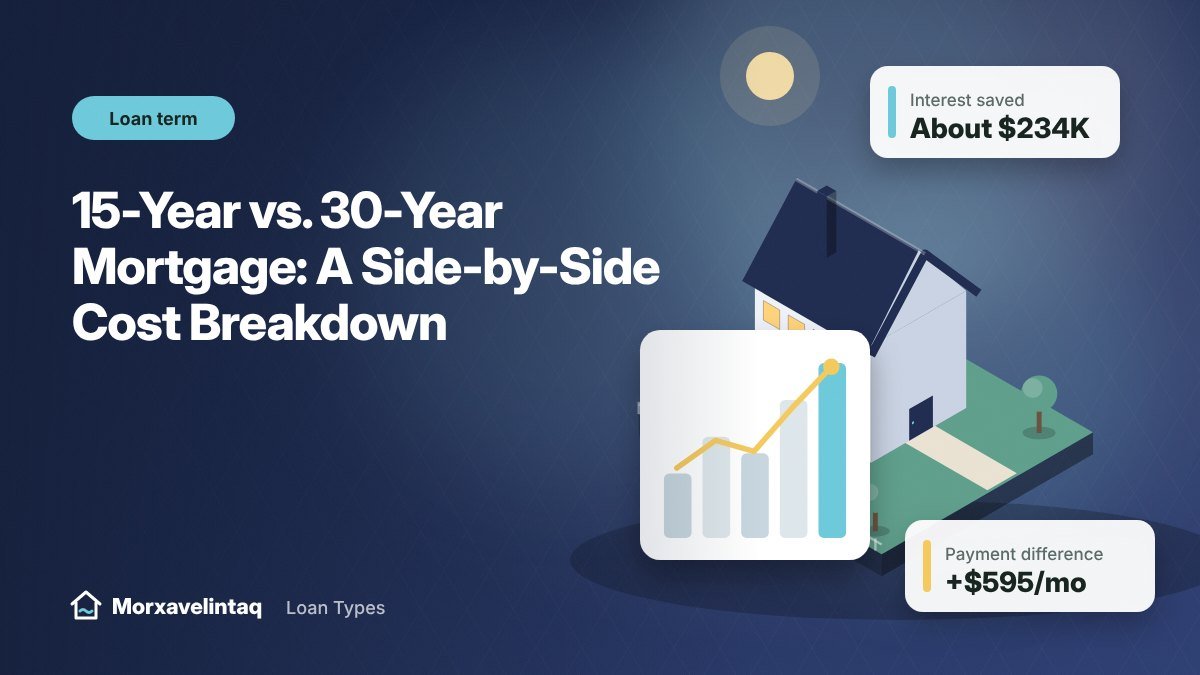
The 15-year loan costs about $595 more per month but saves more than $230,000 in interest. It also builds equity much faster. After five years, the 15-year borrower has paid down far more principal than the 30-year borrower.
Why 15-year loans cost so much less
- Lower rate: lenders take less risk over a shorter period, so they charge less.
- Faster principal reduction: each payment chips away more of the balance, so interest is charged on a smaller amount sooner.
- Fewer years of interest: half as many payments means half as many months for interest to accumulate.
Who a 15-year mortgage fits
- Buyers with stable, high income who can comfortably afford the larger payment and still save for retirement and emergencies.
- Homeowners refinancing later in their careers who want to be debt-free by retirement.
- People who value guaranteed savings over investment flexibility.
Who a 30-year mortgage fits
- First-time buyers stretching to afford a home.
- Households with variable income who want a low required payment.
- Borrowers who prefer to invest extra money elsewhere or build emergency savings.
- Anyone who wants the flexibility to pay extra when they can, without being required to.
The middle path: 30-year loan, 15-year habits
Most mortgages allow extra principal payments without penalty. If you take a 30-year loan but pay an extra amount each month toward principal, you can shorten the term substantially while keeping the lower required payment as a safety net. You won't get the lower 15-year rate, though, so you'll pay somewhat more interest than a true 15-year loan. Our guide to paying off your mortgage early shows how.
What about 20-year and 10-year terms?
Many lenders offer 10-, 20- and 25-year fixed terms. A 20-year loan is a useful compromise, with a payment between the two and significant interest savings over 30 years. Ask lenders to quote multiple terms side by side.
A quick decision framework
If you're torn between terms, work through these questions in order:
- Is the 15-year payment under about 25% of your take-home pay? If not, the 30-year term is usually the safer choice.
- Do you have an emergency fund of at least three to six months of expenses? A higher required payment leaves less room for surprises.
- Are you contributing enough to retirement to get any employer match? Skipping a 401(k) match to pay down a mortgage faster usually costs more than it saves.
- Do you carry high-interest debt? Credit cards and personal loans should generally be paid off before you commit to a higher mortgage payment.
- How stable is your income? Commission, seasonal, or single-income households benefit from the flexibility of a lower required payment.
If you answered yes to the first four and your income is stable, the 15-year loan is likely a strong choice. Otherwise, a 30-year loan with optional extra principal payments gives you most of the benefit without the risk.
Equity after five and ten years
Using the same $300,000 example, the 15-year borrower would owe roughly $227,000 after five years and roughly $130,000 after ten. The 30-year borrower would owe roughly $281,000 after five years and roughly $254,000 after ten. That faster equity build gives the 15-year borrower more options to refinance, borrow against the home or sell profitably if plans change.
Frequently asked questions
Is it harder to qualify for a 15-year mortgage?
Yes, because the higher payment raises your debt-to-income ratio. Some borrowers qualify for a 30-year loan but not a 15-year loan on the same home.
Can I refinance from 30 years to 15 years later?
Yes. It's a common move when rates fall or income rises. See our refinance break-even guide.
Does mortgage interest deduction change the math?
Only if you itemize deductions. Many households take the standard deduction, so the interest deduction may not benefit them.