Key takeaways
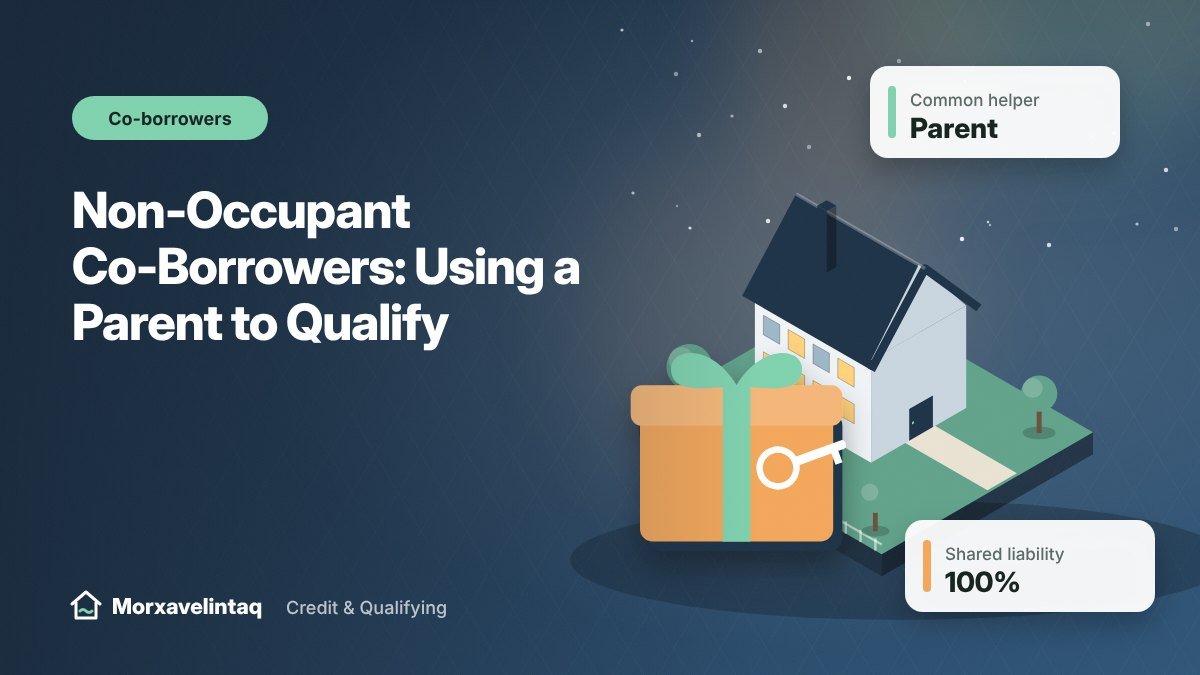
- A non-occupant co-borrower signs the mortgage and adds their income, but doesn't live in the home.
- FHA allows family members to be non-occupant co-borrowers while keeping the 3.5% minimum down payment.
- Conventional loans can blend incomes, with specific debt-to-income rules.
- The co-borrower is fully responsible for the debt, and it counts against their own future borrowing.
When your income alone doesn't quite qualify you for the home you need, a family member can join the loan as a non-occupant co-borrower. It's common for parents helping adult children, but it's a serious commitment for both sides.
How it works
The co-borrower applies with you. The lender evaluates both borrowers' credit, income and debts. Both sign the promissory note and are equally liable. Usually both are also on the title, though rules vary by program.
FHA rules
- Non-occupant co-borrowers who are family members can help you qualify with the maximum financing (3.5% down).
- Non-family co-borrowers generally limit financing to 75% loan-to-value.
- The co-borrower must have a principal residence in the U.S.
- Lenders typically evaluate the combined debt-to-income ratio.
Conventional rules
- Fannie Mae and Freddie Mac allow non-occupant co-borrowers on one-unit primary residences.
- With automated underwriting, the combined incomes and debts are typically used.
- With manual underwriting, the occupying borrower may need to meet certain ratios on their own.
- Down payment and mortgage insurance follow the standard rules for the loan.
VA and USDA
VA joint loans are limited, generally to a veteran with a spouse or another veteran, and a non-veteran co-borrower reduces the guaranty. USDA requires adult household members' income to count for eligibility, and non-occupant co-borrowers aren't typically allowed.
Example
A young teacher earns $4,200 a month and wants a $240,000 condo. With a $1,850 housing payment and $350 in other debt, her debt-to-income ratio would be 52%, too high to qualify. Her father, who earns $6,500 a month and has a $1,400 mortgage of his own, joins as a non-occupant co-borrower on an FHA loan. Combined income is $10,700 and combined debts are $3,600, for a 33.6% ratio, and the loan is approved with 3.5% down.
What co-borrowers need to understand
- Full liability: if payments stop, the lender can pursue either borrower.
- Credit impact: the loan appears on the co-borrower's credit report. Late payments hurt both scores.
- Future borrowing: the payment counts in the co-borrower's debt ratio when they apply for credit, unless they can show the occupant has made payments for 12 months or more, depending on the lender.
- Ownership: being on title can affect estate planning, gift taxes and capital gains. Talk to a professional.
Exiting the arrangement later
Once the occupant's income grows, they can refinance into their own name to release the co-borrower. Plan for this from the start.
Alternatives to consider
- A gift for the down payment instead of co-signing
- Down payment assistance programs
- A less expensive home or a lower-tax area
Putting the arrangement in writing
Even within families, a short written agreement between the occupant and the co-borrower can prevent misunderstandings. Consider covering who makes the monthly payments and from which account, what happens if the occupant can't pay for a few months, whether and when the occupant will refinance to release the co-borrower, how equity will be split if the home is sold, and what happens if either party passes away or wants out. An attorney can help draft the agreement and advise on title options, such as whether the co-borrower should be on the deed.
Protecting the co-borrower's credit
Because the loan appears on both credit reports, the co-borrower should have online access to the mortgage account and receive payment notifications. Setting up autopay from the occupant's account, with alerts to both parties, lets the co-borrower spot a problem before it becomes a 30-day late payment. These simple steps keep the arrangement from damaging the relationship or the co-borrower's ability to borrow for their own needs.
When a co-borrower isn't the right answer
A co-borrower should help you qualify for a payment you can genuinely afford, not stretch you into a home that strains your budget. If you need someone else's income just to meet the minimum ratios, consider whether a smaller or less expensive home would give you a more comfortable start. Making the payments on your own from day one protects both your finances and your family relationships.
Frequently asked questions
Is a co-signer the same as a co-borrower?
In mortgages, lenders usually treat co-signers as co-borrowers who sign the note. Both are fully responsible.
Does the co-borrower need good credit?
Yes. Lenders commonly use the lower middle score of the borrowers, so a weaker score can raise your rate.
Can a co-borrower be removed later?
Usually by refinancing in the occupant's name, once they qualify alone.