Key takeaways
- Down payment assistance (DPA) comes as grants, forgivable loans, deferred loans or low-interest second mortgages.
- Your state housing finance agency is the best starting point, followed by city and county programs.
- Most programs have income limits, purchase price limits and a homebuyer education requirement.
- Read the repayment terms. Some "assistance" must be paid back when you sell or refinance.
Saving for a down payment is the biggest hurdle for many first-time buyers. Thousands of assistance programs across the U.S. help bridge that gap, yet many eligible buyers never hear about them. Here's how these programs work and a practical process for finding the ones you qualify for.
Types of down payment assistance
| Type | How it works | Repayment |
|---|---|---|
| Grant | Money toward your down payment or closing costs | None, though some require you to live in the home for a set period |
| Forgivable loan | A second loan forgiven gradually, often over 5 to 10 years | Only if you sell or refinance before the forgiveness period ends |
| Deferred-payment loan | A 0% second loan with no monthly payment | Due in full when you sell, refinance or pay off the first mortgage |
| Low-interest second mortgage | A small second loan with its own monthly payment | Monthly, alongside your main mortgage |
| Matched savings | Programs that match what you save, sometimes 2 or 3 to 1 | None, if you meet the savings and education requirements |
Who usually qualifies
- First-time buyers, often defined as anyone who hasn't owned a home in the past three years.
- Households under an income limit, commonly set as a percentage of the area median income.
- Buyers purchasing under a price limit that varies by county.
- Owner-occupants. DPA is for your primary residence, not investment property.
- Buyers who complete a homebuyer education course, frequently online and lasting a few hours.
Some programs target specific groups, such as teachers, police officers, firefighters, health care workers, veterans, or buyers in designated revitalization neighborhoods.
How to find programs in your state, step by step
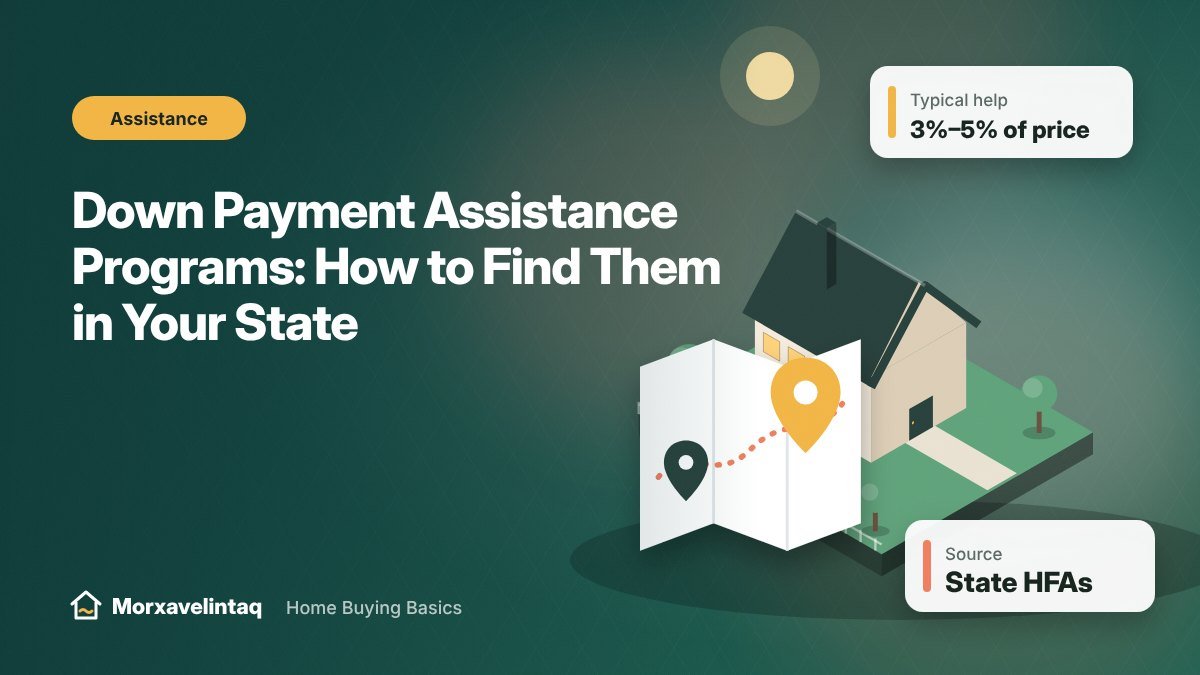
- Start with your state housing finance agency. Every state has one. Search for your state's name plus "housing finance agency." Their websites list statewide DPA programs and the lenders approved to offer them.
- Check city and county housing departments. Large cities often run their own programs that can be stacked with state aid.
- Use HUD's local resources. HUD's website links to state and local homebuying programs and lists HUD-approved housing counseling agencies that know local options well.
- Ask employers and unions. Some hospitals, universities and large employers offer homebuying benefits.
- Talk to lenders who participate. Not every lender offers every program. Ask specifically, "Which down payment assistance programs are you approved for?"
The catches to watch for
- Higher interest rates. Some DPA programs pair the assistance with a first mortgage priced slightly above market. Compare the total cost with and without assistance.
- Repayment triggers. Selling or refinancing within a few years can make a forgivable or deferred loan due.
- Slower closings. Programs with limited funding or agency review can add days or weeks. Build that into your contract timeline.
- Seller perception. In competitive markets, some sellers worry DPA offers will close slowly. A strong pre-approval and a lender experienced with the program help.
Example: a buyer purchasing a $250,000 home with an FHA loan needs $8,750 for a 3.5% down payment. A state program offering a forgivable second loan of 4% of the price provides $10,000, covering the down payment and part of the closing costs. If the buyer stays in the home for the full forgiveness period, nothing is repaid.
Combining DPA with your loan
Most DPA works with FHA, conventional, VA and USDA loans, though each program has its own list. Conventional programs like Fannie Mae's HomeReady and Freddie Mac's Home Possible already allow 3% down and are frequently paired with assistance. Our guide on FHA vs. conventional loans can help you pick the right base loan.
Questions to ask before you accept assistance
- Is this a grant, a forgivable loan, or a loan I'll repay? If repayable, when and how?
- Does the program require a specific first mortgage, and how does its rate compare to the market?
- What income and purchase price limits apply in my county?
- Is there a homebuyer education course, and how long does it take?
- How long does the program add to a typical closing?
- What happens if I refinance, rent out the home, or sell within the first few years?
Write the answers down and compare at least two scenarios with your lender: one with assistance and one without. Sometimes the assistance is worth thousands; occasionally, the higher rate attached to it costs more over time than the help provides.
Frequently asked questions
Is down payment assistance taxable?
Grants for a home purchase are generally not treated as taxable income for the buyer in most cases, but rules can vary. Confirm with a tax professional.
Can I get assistance if I've owned a home before?
Often yes, if you haven't owned in the past three years. Some programs are open to repeat buyers as long as you meet income limits.
How much assistance can I get?
Common amounts range from a few thousand dollars to 3% to 5% of the purchase price. High-cost cities sometimes offer more.