Key takeaways
- A recast lets you make a large principal payment and have your lender recalculate a lower monthly payment over the remaining term.
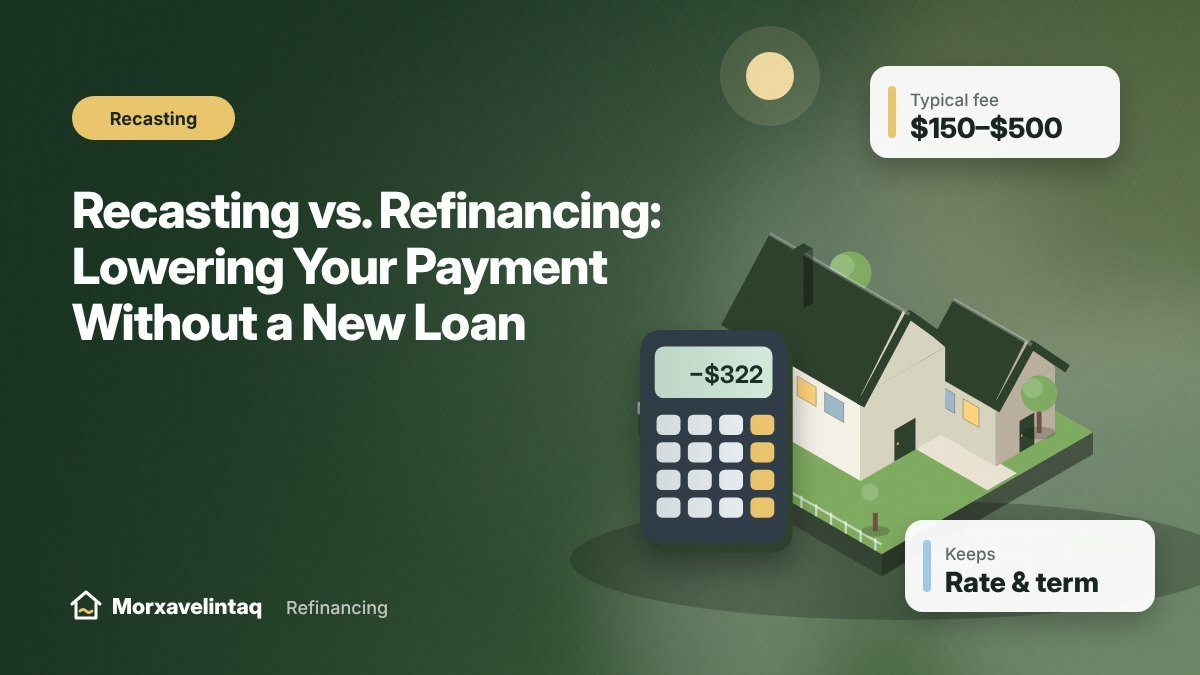
- Your interest rate and loan term stay the same; fees are usually a few hundred dollars.
- Recasting is available on many conventional loans but generally not on FHA, VA or USDA loans.
- It's ideal when you have cash from a home sale or windfall and already like your rate.
If you have a low mortgage rate and come into a lump sum, refinancing to lower your payment would mean giving up that rate. A recast offers a different path: keep the loan, pay down principal, and lower the payment.
How a recast works
- You make a lump-sum principal payment, often with a minimum such as $5,000 or $10,000, depending on the servicer.
- You request a recast and pay a fee, commonly $150 to $500.
- The servicer re-amortizes the lower balance over the remaining term at your existing rate.
- Your new, lower monthly payment begins, usually within one or two billing cycles.
Example: a homeowner owes $250,000 at 6% with 25 years remaining. The monthly principal and interest is about $1,611. After selling a previous home, they pay $50,000 toward principal and recast. The new payment on $200,000 over 25 years at 6% is about $1,289, saving roughly $322 a month for a $250 fee.
Recast vs. refinance at a glance
| Recast | Refinance | |
|---|---|---|
| Interest rate | Unchanged | New rate |
| Term | Unchanged | New term |
| Costs | Usually $150–$500 | Usually 2%–5% of loan |
| Credit check / appraisal | No | Usually yes |
| Lump sum needed | Yes | No |
| Can lower your rate | No | Yes |
| Available on FHA/VA/USDA | Generally no | Yes |
Who benefits most from recasting
- Buyers who purchased before selling their old home and want to lower payments once the sale closes.
- Homeowners with an inheritance, bonus or settlement who want lower monthly costs without losing a good rate.
- Retirees looking to reduce fixed expenses.
Recast vs. simply prepaying principal
Any extra principal payment reduces interest and shortens your loan, but your required payment doesn't change unless you recast. If your goal is a lower monthly obligation, recast. If your goal is paying the loan off sooner, extra payments without a recast work. See paying off your mortgage early.
Things to consider before recasting
- Liquidity: money put into your home is hard to get back without borrowing. Keep a healthy emergency fund.
- Opportunity cost: if your rate is very low, you might earn more elsewhere or pay off higher-interest debt first.
- Servicer rules: ask about minimum lump sums, fees, and whether your loan is eligible.
How to request a recast, step by step
- Call your servicer and ask whether your loan is eligible for a recast, the minimum lump-sum amount, and the fee.
- Confirm the process. Some servicers require a written request form; others accept a phone request after the lump sum posts.
- Send the lump sum designated clearly as a principal reduction, usually by wire or certified funds.
- Request the recast and pay the fee once the payment posts.
- Get the new payment in writing. Your servicer should send an updated amortization schedule or payment letter.
- Update autopay so you don't keep paying the old amount by accident, unless you want the extra to go toward principal.
Recasting after buying before selling
One of the most common recast situations is a homeowner who buys a new home before selling the old one. They take a larger mortgage to close quickly, then use the proceeds from the old home's sale to pay down principal and recast. This lets them qualify for the purchase, avoid a contingent offer, and end up with a payment based on the smaller balance, all while keeping the rate they locked at purchase. If you're planning this strategy, confirm before you buy that your new loan will allow a recast and what the minimum lump sum is.
Running the numbers on your own loan
To estimate your new payment, use any mortgage calculator: enter your balance after the lump sum, your current rate, and the number of months left on your loan. The result is your new principal and interest payment. Add your escrow amount to get the full monthly payment.
Frequently asked questions
Can I recast more than once?
Some servicers allow multiple recasts; others limit them. Ask your servicer.
Does recasting affect my credit?
No hard credit inquiry is typically required, and the loan account stays the same.
Can I recast an FHA loan?
Generally no. FHA, VA and USDA loans usually can't be recast. Making extra principal payments still saves interest, though the required payment won't drop.