Key takeaways
- One discount point costs 1% of your loan amount and lowers your interest rate by an amount the lender sets, often around a quarter of a percentage point.
- Divide the cost of points by the monthly savings to find your break-even point in months.
- Points pay off when you keep the loan well past the break-even point, without refinancing or selling.
- Points aren't the same as origination fees, even though both appear on your Loan Estimate.
When you get a mortgage quote, you'll often see options: a higher rate with no points, or a lower rate if you pay points upfront. This is essentially prepaying interest. Whether it's smart depends on one question: how long will you keep this loan?
How points work
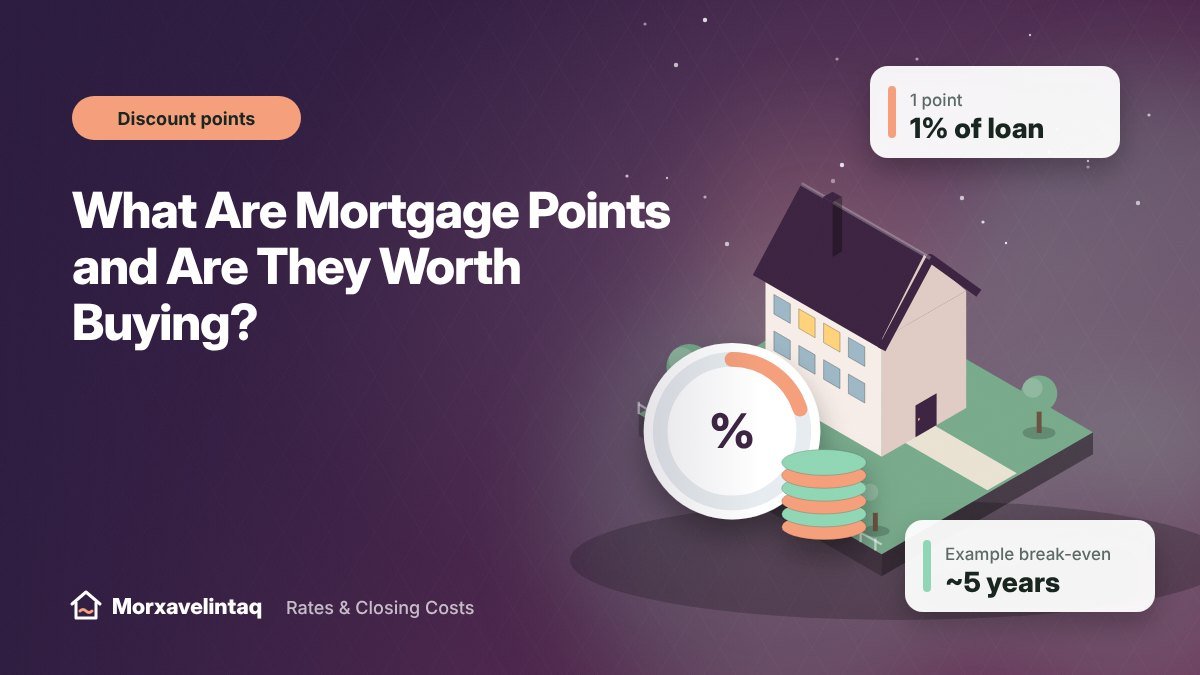
A discount point equals 1% of the loan amount. On a $300,000 loan, one point costs $3,000. The rate reduction per point isn't fixed; it varies by lender, loan type and market conditions. Lenders can also offer fractional points, like 0.5 or 1.25.
Some quotes go the other direction: a slightly higher rate in exchange for a lender credit toward closing costs. These are sometimes called negative points.
Calculating your break-even point
On a $300,000, 30-year fixed loan:
- Option A: 6.75% with no points. Payment: $1,946
- Option B: 6.50% with 1 point ($3,000). Payment: $1,896
Monthly savings: about $50. Break-even: $3,000 ÷ $50 = about 60 months, or 5 years. If you keep the loan longer than five years, the point saves money. If you refinance or sell sooner, you lose.
When buying points makes sense
- You plan to stay in the home and keep the loan well beyond the break-even point.
- You have extra cash after covering your down payment, closing costs and emergency savings.
- Rates are relatively low and you don't expect to refinance.
- A seller is offering concessions that can be used to buy down your rate.
When to skip points
- You may move or refinance within a few years.
- Rates seem likely to fall, making a future refinance attractive.
- Paying points would drain your cash reserves.
- You'd get more value putting the same money toward a larger down payment, especially if it helps you avoid or reduce mortgage insurance.
Points vs. a bigger down payment
Instead of $3,000 in points, you could add $3,000 to your down payment. A larger down payment lowers the balance slightly. If it pushes you across an important threshold, like 20% down to avoid PMI or a better pricing tier, the down payment often wins. Otherwise, compare the monthly savings from each.
Temporary buydowns are different
A 2-1 buydown lowers your rate by 2 points in year one and 1 point in year two, then returns to the full note rate. It's usually paid by the seller or builder as a concession. Unlike discount points, it doesn't lower your rate permanently. It can ease the first two years, but you must qualify at the full rate.
Are points tax-deductible?
Points paid on a purchase of your main home can often be deducted in the year paid if you itemize and meet IRS conditions. Points on a refinance are generally deducted over the life of the loan. Check IRS Publication 936 or ask a tax professional.
How to compare offers fairly
Ask each lender to quote the same loan amount, term and lock period at two price points: zero points, and one point. Compare the rate, points cost and lender credits on each Loan Estimate. Our guide on comparing Loan Estimates walks through the sections, and our APR vs. interest rate guide explains why APR reflects points.
Points on different loan types
Discount points are available on conventional, FHA, VA and USDA loans, but there are a few program-specific rules. VA allows discount points to be paid by the veteran or the seller, and on IRRRLs up to two discount points can be financed into the loan. FHA and conventional loans generally allow points to be paid by the borrower or covered by seller concessions within program limits. On every loan type, ask the lender to show the rate without points first, so you can see exactly how much each point buys.
A quick worksheet
- Write down the no-point rate and payment.
- Write down the rate and payment with one point, and the point's dollar cost.
- Subtract the payments to get monthly savings.
- Divide the point cost by monthly savings to get break-even months.
- Compare that to how long you expect to keep the loan before selling or refinancing.
If the break-even is less than half your expected holding period, points are likely a good buy. If it's close to or longer than your expected holding period, skip them.
Frequently asked questions
Can I negotiate points?
Yes. Pricing differs between lenders, and asking competing lenders to match a quote is common.
Can the seller pay for my points?
Yes, seller concessions can usually be used for discount points, within your loan program's concession limits.
Are points the same as origination fees?
No. Origination fees pay the lender for processing the loan and don't lower your rate. Discount points buy a lower rate.