Key takeaways
- A home equity loan gives you a lump sum at a fixed rate with fixed payments.
- A HELOC gives you a revolving credit line, usually at a variable rate, and you pay interest only on what you use.
- Choose a home equity loan for a single, known cost. Choose a HELOC for expenses spread over time.
- Both keep your first mortgage intact, which matters if your current rate is low.
Both products let you borrow against your home's equity without replacing your first mortgage. The key difference is predictability versus flexibility.
Side-by-side comparison
| Home equity loan | HELOC | |
|---|---|---|
| How you get money | One lump sum at closing | Draw as needed up to a limit |
| Interest rate | Usually fixed | Usually variable |
| Payments | Fixed principal and interest | Often interest-only during the draw period, then principal and interest |
| Interest charged on | Full amount from day one | Only the amount drawn |
| Typical terms | 5 to 30 years | Draw period plus repayment period |
| Closing costs | Often 2%–5%, sometimes waived | Often low or none; possible annual fee |
| Best for | One-time expenses with a known cost | Ongoing or uncertain expenses |
Example: a $75,000 kitchen remodel
- Home equity loan: $75,000 at 8% fixed over 15 years. Payment: about $717 a month, unchanged for the entire term.
- HELOC: you draw $25,000 at the start, $30,000 two months later and $20,000 at the end. During construction, you pay interest only on what's drawn. Once the project's done, your interest-only payment on $75,000 at 8.5% would be about $531, but it will rise when repayment begins or if rates go up.
When a home equity loan is the better fit
- You know the exact cost, like a roof replacement or debt consolidation.
- You want a fixed rate and a payment that never changes.
- You want discipline: no temptation to keep borrowing.
When a HELOC is the better fit
- Costs will come in stages, like a phased renovation or college tuition.
- You want an emergency backstop you may never use.
- You expect to repay the balance relatively quickly.
Risks with both
- Your home secures the loan. Falling behind can lead to foreclosure.
- Borrowing reduces your equity cushion if home values drop.
- Using equity to pay off credit cards only works if you avoid building up new card debt.
Qualifying requirements
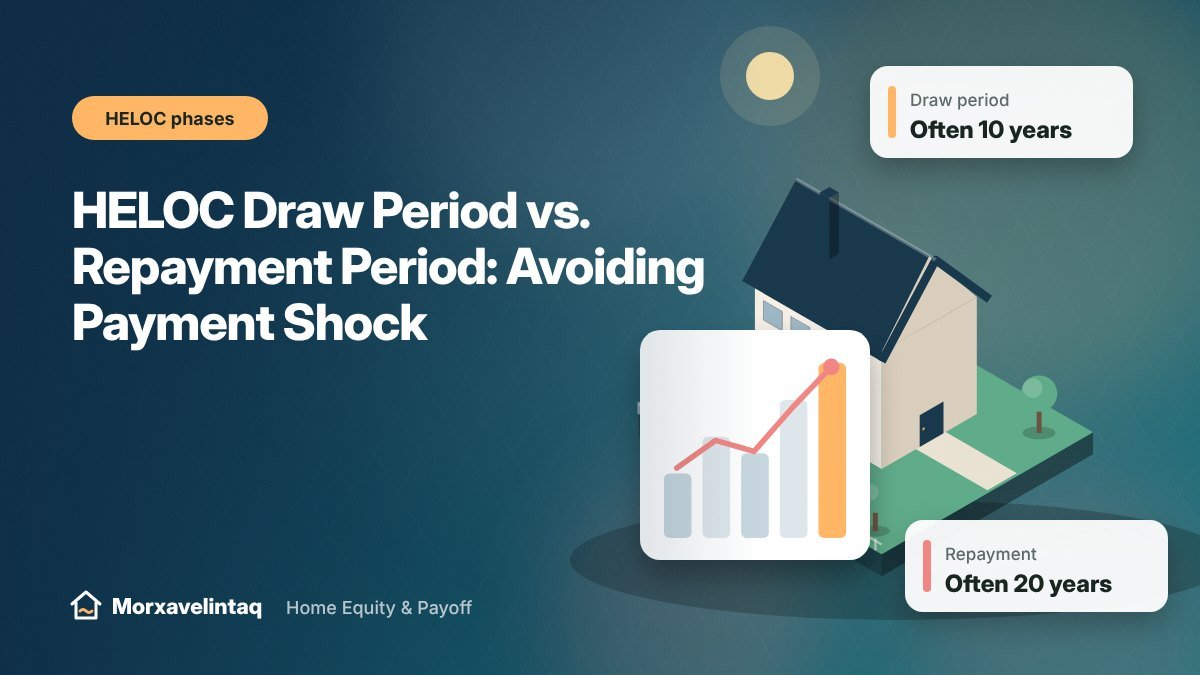
Lenders usually look for a credit score of 620 to 680 or higher, a debt-to-income ratio below about 43%, and combined loan-to-value of 80% to 90% or less. See how to calculate your home equity to estimate your borrowing limit, and HELOC draw vs. repayment to understand how HELOC payments change.
Choosing for common situations
| Situation | Usually better | Why |
|---|---|---|
| Single contractor bid for a new roof | Home equity loan | Known cost, one payment, fixed rate |
| Multi-phase remodel over a year | HELOC | Pay interest only on what's drawn |
| Consolidating $40,000 of credit card debt | Home equity loan | Fixed payoff date and no temptation to redraw |
| Four years of college tuition | HELOC | Draw each semester as bills arrive |
| Emergency backup fund | HELOC | No interest unless used |
| Rising-rate environment, long payoff | Home equity loan | Protects against rate increases |
Hybrid options
Some lenders offer HELOCs with a fixed-rate lock feature, letting you convert part of your balance to a fixed rate and fixed payment while keeping the rest of the line available. This can give you the flexibility of a HELOC with some of the predictability of a home equity loan. Ask about lock fees, how many locks are allowed, and the minimum amount for each lock.
Shopping tips
Compare offers from your current bank, a credit union and at least one online lender. Look beyond the introductory rate: for HELOCs, compare the margin over the prime rate, since that determines your rate after any promotional period. For home equity loans, compare the APR and closing costs. Ask whether the lender will cover closing costs if you keep the account open for a minimum period, often three years.
Closing timeline and documents
Both products typically require income documentation, a credit check and some form of home valuation. Many lenders use automated valuations for smaller lines, while larger amounts often require a full appraisal. Expect to provide pay stubs, W-2s or tax returns, a mortgage statement, and homeowners insurance details. Federal rules give you a three-day right of rescission after closing on most home equity loans and HELOCs on your primary residence, so funds are usually available a few days after signing.
Frequently asked questions
Can I have both a home equity loan and a HELOC?
It's possible if you have enough equity and the lender allows a third lien, but it's uncommon.
Is interest tax-deductible?
Generally only when used to buy, build or substantially improve the home, and only if you itemize. Ask a tax professional.
Which is faster to get?
Timelines are similar, typically two to six weeks, depending on the appraisal and lender.