Key takeaways
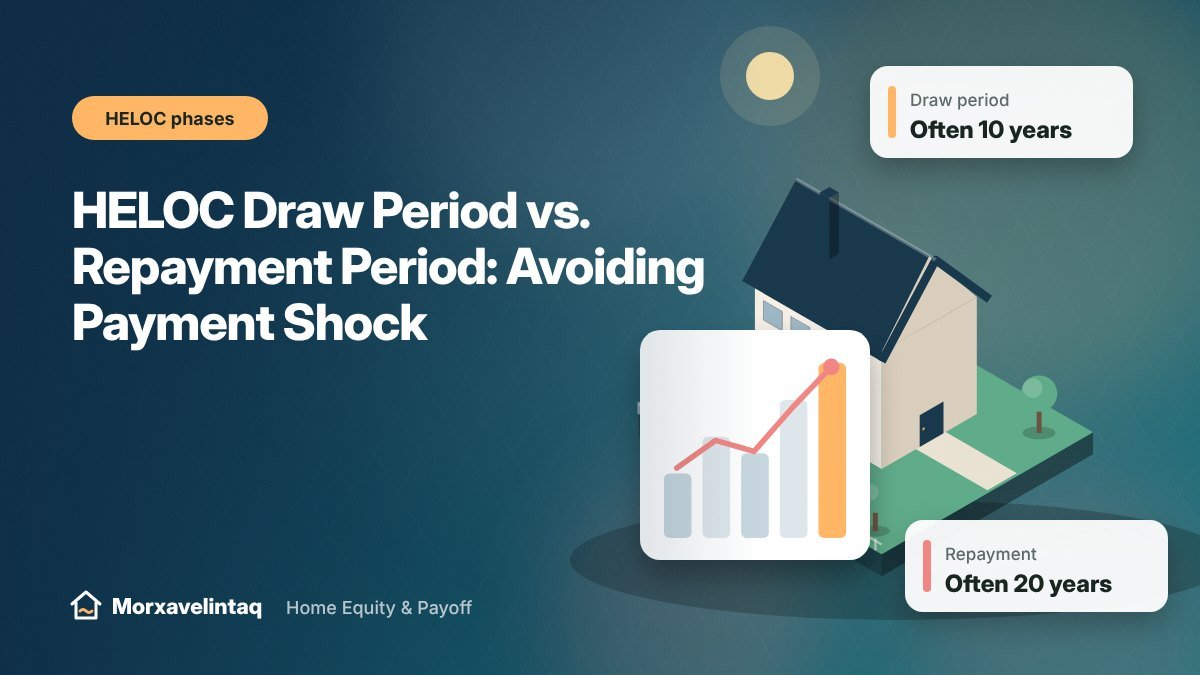
- Most HELOCs have a draw period (often 10 years) when you can borrow, followed by a repayment period (often 20 years) when you can't.
- Many HELOCs allow interest-only payments during the draw period.
- When repayment starts, payments include principal and can rise sharply.
- HELOC rates are usually variable, adding another source of payment change.
A home equity line of credit (HELOC) works like a credit card secured by your home. It's flexible and often inexpensive to open, but its two-phase structure catches many borrowers off guard years later.
The draw period
During the draw period, you can borrow up to your credit limit, repay and borrow again. Many lenders require only interest payments during this phase, though you can pay principal too. Draw periods commonly last 5 to 10 years.
The repayment period
When the draw period ends, the line closes to new borrowing. Your outstanding balance is amortized over the repayment period, commonly 10 to 20 years, so each payment includes principal and interest. Some HELOCs instead require the full balance as a balloon payment at the end of the draw period. Read your agreement carefully.
Example: payment shock in numbers
You owe $80,000 on a HELOC at 8.5%.
- Interest-only payment during the draw period: about $567 a month
- Principal and interest over a 20-year repayment period: about $694 a month
That's a 22% increase overnight, even if the rate doesn't change. If rates rise at the same time, the jump is bigger. With a shorter 10-year repayment period, the new payment would be close to $1,000.
Variable rates add another layer
Most HELOCs use the prime rate plus a margin. When the Federal Reserve changes short-term rates, the prime rate usually follows, and your HELOC rate adjusts, often monthly. Check whether your HELOC has a rate cap and whether you can convert part of the balance to a fixed rate.
How to avoid payment shock
- Pay principal during the draw period. Even an extra $100 to $200 a month reduces the balance you'll amortize later.
- Use a fixed-rate conversion option if your lender offers one, to lock the rate on a portion of the balance.
- Calculate the repayment payment now using your current balance and rate, so you're not surprised.
- Refinance the HELOC into a fixed home equity loan or new HELOC before the draw period ends, if rates and your credit allow.
- Consider a cash-out refinance if it also lowers your first mortgage rate. See cash-out refinance vs. HELOC.
Know your dates
Find your draw period end date in your HELOC agreement or online account. Many lenders send a notice before repayment begins, but don't count on it. Mark the date on your calendar a year ahead so you have time to plan.
Fees to watch for
- Annual fees during the draw period
- Inactivity fees if you don't use the line
- Early closure fees if you close the line within the first few years
- Minimum draw requirements
A simple plan for HELOC borrowers
- Find your numbers today: current balance, rate, margin, draw period end date and repayment term.
- Calculate the future payment by entering your balance, current rate and repayment term into a mortgage calculator.
- Stress-test it: add two percentage points to the rate and recalculate. Could you afford that payment?
- Set a paydown target: decide how much principal to pay each month during the draw period to bring the future payment into a comfortable range.
- Review annually: check your balance and rate each year, and reconsider a fixed-rate conversion or refinance if rates or your plans change.
If you're already facing payment shock
If your repayment period has started and the new payment is a strain, contact your lender promptly. Options may include a loan modification, an extended repayment term, or refinancing the balance into a fixed-rate home equity loan or a new first mortgage. Missing HELOC payments puts your home at risk, so ask for help before you fall behind. A HUD-approved housing counselor can review your options for free or at low cost.
Reading your HELOC agreement
Key terms to find in your agreement include the draw period length, the repayment period length, the index and margin, any rate floor or cap, minimum payment rules during each phase, whether a balloon payment applies, and conditions under which the lender can freeze or reduce your line. If any term is unclear, ask the lender to explain it in writing.
Frequently asked questions
Can I extend my HELOC draw period?
Some lenders offer renewals or new HELOCs, but it requires qualifying again. It's not guaranteed.
Can I pay off a HELOC early?
Usually yes, though some lenders charge early closure fees in the first few years.
What happens if my home value drops?
Lenders can freeze or reduce your credit line if values decline significantly, as many did in 2008.