Key takeaways
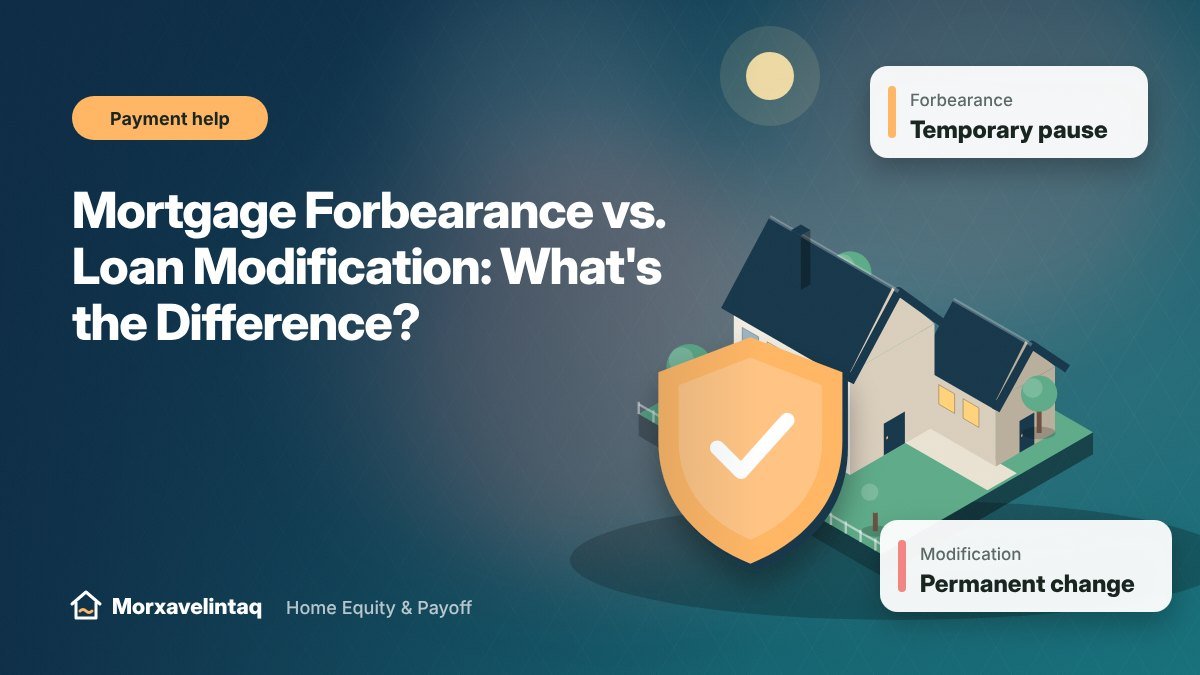
- Forbearance temporarily pauses or reduces payments during a short-term hardship. The missed amount must be repaid later.
- A loan modification permanently changes your loan terms, such as the rate, term or balance, to make payments affordable.
- Forbearance often leads to a repayment plan, payment deferral, or modification afterward.
- Call your servicer as soon as you expect trouble; options shrink once you fall behind.
Job loss, illness, divorce or a natural disaster can make mortgage payments difficult. Servicers have tools to help, but they work differently. Knowing which one fits your situation helps you ask for the right thing.
What forbearance does
Forbearance is a temporary agreement to suspend or reduce payments, often for three to six months, sometimes with extensions. Interest generally continues to accrue. It's designed for hardships expected to end, like temporary unemployment or recovery from a disaster.
What happens after forbearance ends
| Option | How it works |
|---|---|
| Lump-sum reinstatement | Repay all missed payments at once. Not required on most government-backed and Fannie/Freddie loans if you can't afford it. |
| Repayment plan | Pay the regular payment plus a portion of the missed amount for several months. |
| Payment deferral or partial claim | Missed payments move to the end of the loan or into a no-interest balance due when you sell, refinance or pay off the loan. |
| Loan modification | Permanently change terms if you can't return to your old payment. |
What a loan modification does
A modification permanently changes your mortgage to lower your payment. Common changes include:
- Adding missed payments to the balance
- Extending the term, for example to 40 years
- Lowering the interest rate
- In some cases, deferring part of the principal without interest
Most modifications begin with a trial period of about three months. If you make the trial payments on time, the modification becomes permanent.
Side-by-side comparison
| Forbearance | Loan modification | |
|---|---|---|
| Duration | Temporary | Permanent |
| Best for | Short-term hardship | Long-term change in finances |
| Payment change | Paused or reduced temporarily | Permanently lower |
| Missed payments | Must be resolved later | Usually rolled into the loan |
| Documentation | Often minimal | Income and hardship documentation |
Credit impact
How forbearance is reported depends on your agreement and the circumstances; being in an approved plan is very different from simply missing payments. Modifications may be noted on your credit report. Either way, both are generally far better for your credit and finances than foreclosure. Ask your servicer how the arrangement will be reported.
How to ask for help
- Call your servicer's loss mitigation department as soon as you anticipate a problem.
- Explain your hardship and how long you expect it to last.
- Ask about all options, including forbearance, repayment plans, deferral and modification.
- Submit a complete application with requested documents quickly.
- Get every agreement in writing.
A HUD-approved housing counselor can help you navigate the process at no or low cost. Beware of companies that charge upfront fees to get you a modification; that's illegal in most cases.
Documents to have ready when you call your servicer
- A short written description of your hardship and when it started
- Recent pay stubs or proof of unemployment benefits
- Your most recent federal tax return
- Two months of bank statements
- A monthly budget showing income and expenses
- Any documents related to the hardship, such as a layoff notice, medical bills or a divorce decree
Having these ready speeds up the review, especially for a modification. Keep a log of every call: the date, the representative's name, and what they told you. Federal mortgage servicing rules require servicers to acknowledge loss mitigation applications and, once complete, evaluate you for all available options within set timeframes.
Protections against foreclosure while you apply
Under federal rules, servicers generally can't start the foreclosure process until you're more than 120 days delinquent. If you submit a complete loss mitigation application before foreclosure starts, or at least 37 days before a scheduled foreclosure sale, the servicer generally must evaluate it before moving forward. These protections are one more reason to apply early rather than waiting.
Government-backed loan options
FHA, VA and USDA loans each have their own loss mitigation tools. FHA offers partial claims that move missed payments into an interest-free second lien. VA servicers can offer repayment plans, modifications and, in some cases, VA's own assistance programs. USDA offers its own set of options. Fannie Mae and Freddie Mac loans have payment deferral and Flex Modification programs. Ask your servicer which investor owns your loan, because that determines which options are available.
Frequently asked questions
Does forbearance mean my payments are forgiven?
No. Payments are postponed, not erased. You'll need a plan to repay them.
Can I refinance after forbearance?
Usually, after making a certain number of on-time payments following the forbearance. Rules vary by loan type. See refinancing with bad credit.
Can I sell my home during forbearance?
Yes. The sale would pay off the loan, including the forborne amounts.