Key takeaways
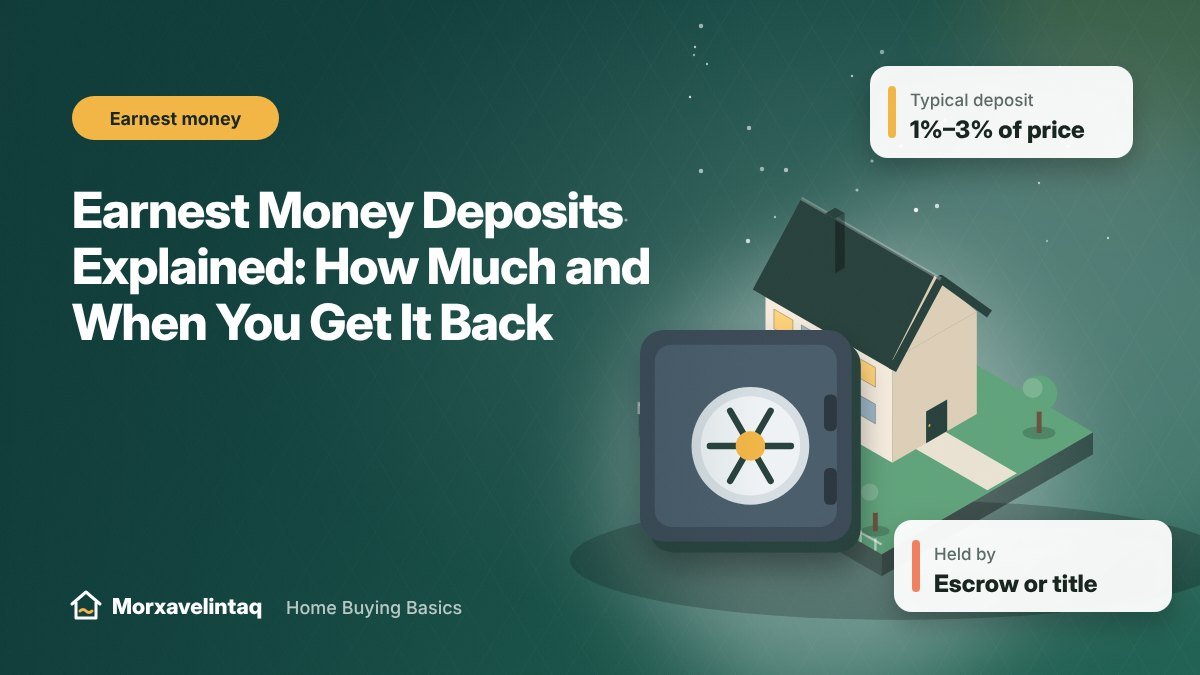
- Earnest money is a good-faith deposit, typically 1% to 3% of the purchase price.
- It's held by a neutral third party, usually a title company, escrow company or brokerage trust account.
- At closing, it's credited toward your down payment or closing costs.
- Contingencies in your contract protect the deposit if inspection, appraisal or financing falls through within the deadlines.
When a seller accepts your offer, they take the home off the market. Earnest money is your promise that you intend to follow through. It isn't an extra fee; it's part of your purchase funds paid early. Understanding how it's protected can save you from losing thousands of dollars on a technicality.
How much earnest money should you offer?
Amounts vary by local custom and market conditions:
- Typical range: 1% to 3% of the purchase price.
- Hot markets: buyers may offer more to stand out.
- Some areas use flat amounts, like $1,000 to $5,000, regardless of price.
- New construction often requires larger deposits, sometimes paid in stages.
Your agent will know what's normal in your area. A larger deposit can signal commitment, but it also means more money at risk if you miss a contract deadline.
Who holds the money?
You don't hand earnest money directly to the seller. It's deposited into an escrow or trust account held by a title company, escrow agent, real estate brokerage or attorney, depending on your state. You'll usually pay by wire transfer or cashier's check within one to three business days of acceptance. Always verify wiring instructions by phone with the title company using a number you look up yourself.
What happens to it at closing
The deposit appears as a credit on your Closing Disclosure, under "Deposit" in the calculating cash to close section. It reduces the amount you bring to closing dollar for dollar. Your lender will also want to see that the funds came from your own verified accounts, so keep the bank statement showing the withdrawal.
How contingencies protect your deposit
| Contingency | What it lets you do | Typical deadline |
|---|---|---|
| Inspection | Cancel or renegotiate after reviewing the home's condition | 7–10 days after acceptance |
| Appraisal | Cancel or renegotiate if the home appraises below the price | Often 17–21 days |
| Financing | Cancel if your loan isn't approved despite good-faith effort | Often 21–30 days |
| Home sale | Cancel if your current home doesn't sell | Negotiated |
| Title | Cancel if title problems can't be resolved | Varies |
The key is timing. If you cancel within a contingency period and follow the contract's notice procedures, you generally get your deposit back. If you cancel after the deadline passes, or for a reason not covered, the seller may be entitled to keep it.
When you could lose your earnest money
- You miss a contingency deadline and then back out.
- You waive contingencies to compete and later can't or won't close.
- You simply change your mind without a contractual reason.
- You fail to close on time because of something within your control, such as not providing loan documents.
Example: a buyer offers $320,000 with $6,400 earnest money and a 10-day inspection contingency. On day 8, the inspector finds a failing roof. The buyer sends a written termination notice on day 9. Because notice was given within the contingency period, the deposit is returned. If the same buyer had waited until day 12, the seller could have claimed the $6,400.
How to get your money back if a deal falls apart
Both parties usually sign a release form instructing the escrow holder to return the funds. If the seller disputes your right to the deposit, the escrow holder generally can't release it until both sides agree or a court or arbitrator decides. Keep copies of every notice and deadline.
Earnest money vs. option fees and due diligence money
In a few states, contracts include an additional payment that works differently from earnest money. In Texas, buyers often pay a small option fee directly to the seller for the unrestricted right to terminate during an option period. In North Carolina, buyers commonly pay a due diligence fee directly to the seller, which is generally nonrefundable unless the seller breaches. These payments are usually credited toward the purchase at closing, but you typically don't get them back if you walk away. Ask your agent to explain every deposit in your local contract before you sign.
Frequently asked questions
Is earnest money the same as a down payment?
Not exactly, but it becomes part of your down payment or closing costs at closing. It's money you would spend anyway, paid early.
Can I use gift funds for earnest money?
Usually yes, with proper documentation such as a gift letter and proof of the transfer. Ask your lender before you send it.
Do VA and FHA loans require earnest money?
The loan programs themselves don't require it, but most sellers expect it as part of the purchase contract.