Key takeaways
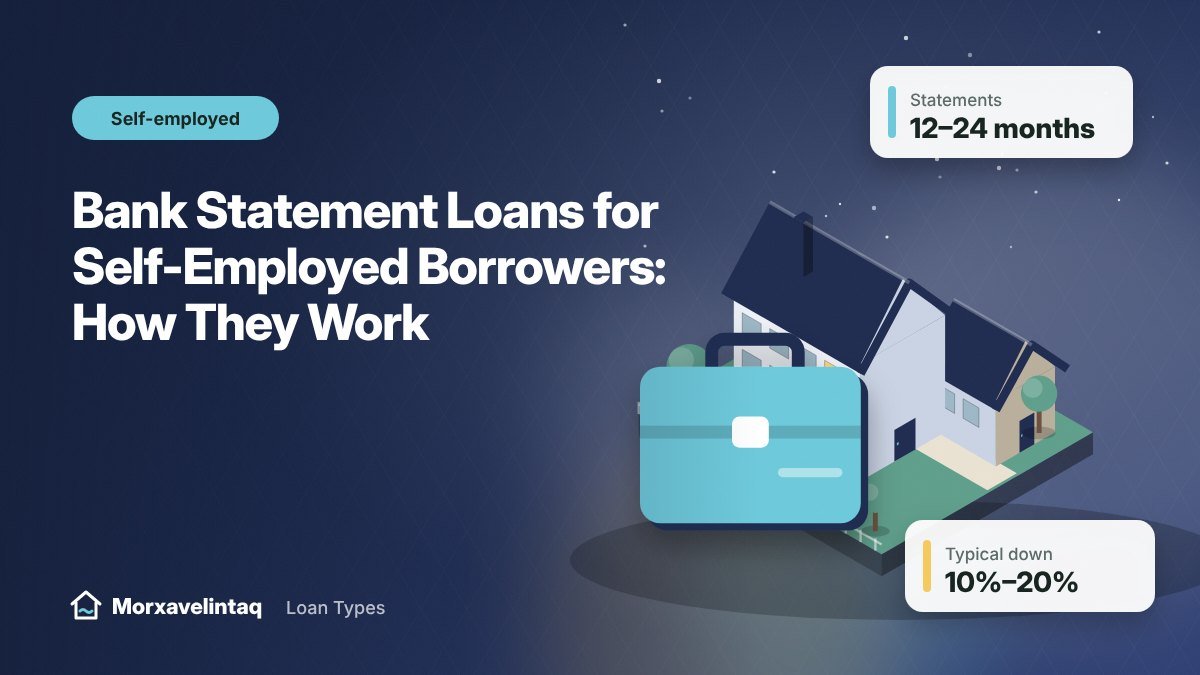
- Bank statement loans are non-qualified mortgages (non-QM) that calculate income from 12 or 24 months of business or personal bank deposits.
- They help self-employed borrowers whose tax returns show low income because of legitimate business deductions.
- Expect higher rates than conventional loans, larger down payments, and reserve requirements.
- Try a conventional loan first; many self-employed borrowers qualify more cheaply than they think.
Self-employed borrowers face a frustrating catch: the deductions that lower your tax bill also lower the income a mortgage lender counts. A business owner with $180,000 in revenue might show $55,000 of taxable income after expenses and depreciation. Bank statement loans were designed for this gap.
How income is calculated
Instead of tax returns, the lender reviews your bank statements and averages your deposits. Exact methods vary by lender, but common approaches include:
- Personal bank statements: the lender averages eligible deposits over 12 or 24 months, excluding transfers between your own accounts.
- Business bank statements: the lender averages deposits and applies an expense factor, often 30% to 50% depending on your industry, or uses a profit-and-loss statement prepared by a CPA.
Example: a freelance designer's business account shows average monthly deposits of $14,000 over 24 months. The lender applies a 50% expense factor, counting $7,000 a month as qualifying income. Her tax returns showed only $4,200 a month after deductions, so the bank statement method nearly doubles her qualifying income.
Typical requirements
| Requirement | Common range |
|---|---|
| Self-employment history | At least 2 years, sometimes 1 year with prior industry experience |
| Credit score | Often 620 to 680 minimum; best pricing at 720+ |
| Down payment | Often 10% to 20% |
| Reserves | 3 to 12 months of payments |
| Proof of business | Business license, CPA letter, or registration documents |
The trade-offs
- Higher rates: non-QM loans usually carry rates noticeably above conventional loans.
- Higher costs: origination fees and points may be higher.
- Prepayment penalties: some non-QM loans, especially for investment properties, include them. Ask before you sign.
- Fewer protections: non-QM loans don't have to meet every qualified-mortgage standard, though lenders still must reasonably verify your ability to repay.
Try these options first
- Conventional with two years of returns: lenders add back certain non-cash deductions, like depreciation and depletion, which can raise your qualifying income.
- Conventional with one year of returns: automated underwriting sometimes accepts one year if your business has been around five years or more.
- FHA: uses tax returns but has more flexible debt ratios.
Plan ahead if you're self-employed
If you plan to buy in the next year or two, talk with your tax preparer about the trade-off between deductions and qualifying income. Keep business and personal finances in separate accounts, avoid large cash deposits, and keep your profit-and-loss statements current. Our guide to the debt-to-income ratio explains how lenders turn that income into a maximum payment.
Common mistakes self-employed borrowers make
- Mixing personal and business funds. When personal expenses run through a business account, or business income lands in a personal account, lenders have a harder time separating real income from transfers. Keep separate accounts for at least 12 to 24 months before applying.
- Large unexplained deposits. Lenders may exclude deposits that don't look like regular business income, such as loans, refunds or transfers from savings. Keep invoices and records that tie deposits to customers.
- Overdrafts and NSF fees. Frequent overdrafts can lead to extra scrutiny or denial on some non-QM programs.
- Declining revenue. Lenders look at trends. If your most recent year shows lower deposits than the year before, expect questions and possibly lower qualifying income.
- Ignoring prepayment terms. If you plan to refinance into a conventional loan in a year or two, choose a loan without a prepayment penalty, or with one that expires before you expect to refinance.
Questions to ask non-QM lenders
- Will you use personal or business statements for my file, and what expense factor applies to my industry?
- Do you require a CPA letter or a profit-and-loss statement?
- What's the rate difference between 12-month and 24-month statement programs?
- Is there a prepayment penalty? If so, how long does it last and how is it calculated?
- How many months of reserves do I need, and which accounts count?
Frequently asked questions
Can I refinance out of a bank statement loan later?
Yes. Many borrowers refinance into a conventional loan once their tax returns show enough income, as long as there's no prepayment penalty or it has expired.
Are bank statement loans legitimate?
Yes. They're offered by licensed lenders and must follow federal ability-to-repay rules, even though they're outside the qualified-mortgage category.
Can 1099 contractors use them?
Yes. Some lenders also offer 1099-only programs that qualify you based on your 1099 forms instead of statements.