Key takeaways
- Seller concessions are credits from the seller toward your closing costs, prepaid items or rate buydowns.
- Each loan program caps concessions as a percentage of the price or loan amount.
- Concessions can't exceed your actual closing costs; they can't be used for your down payment.
- Asking for concessions works best in balanced or buyer-friendly markets, or when an inspection reveals issues.
Closing costs often run 2% to 5% of the loan amount, which is a lot of cash on top of a down payment. Seller concessions let the seller cover part of those costs, either directly or by agreeing to a slightly higher price in exchange for a credit.
Concession limits by loan type
| Loan type | Maximum seller contribution |
|---|---|
| Conventional, less than 10% down | 3% of the price |
| Conventional, 10% to 25% down | 6% of the price |
| Conventional, more than 25% down | 9% of the price |
| Conventional, investment property | 2% of the price |
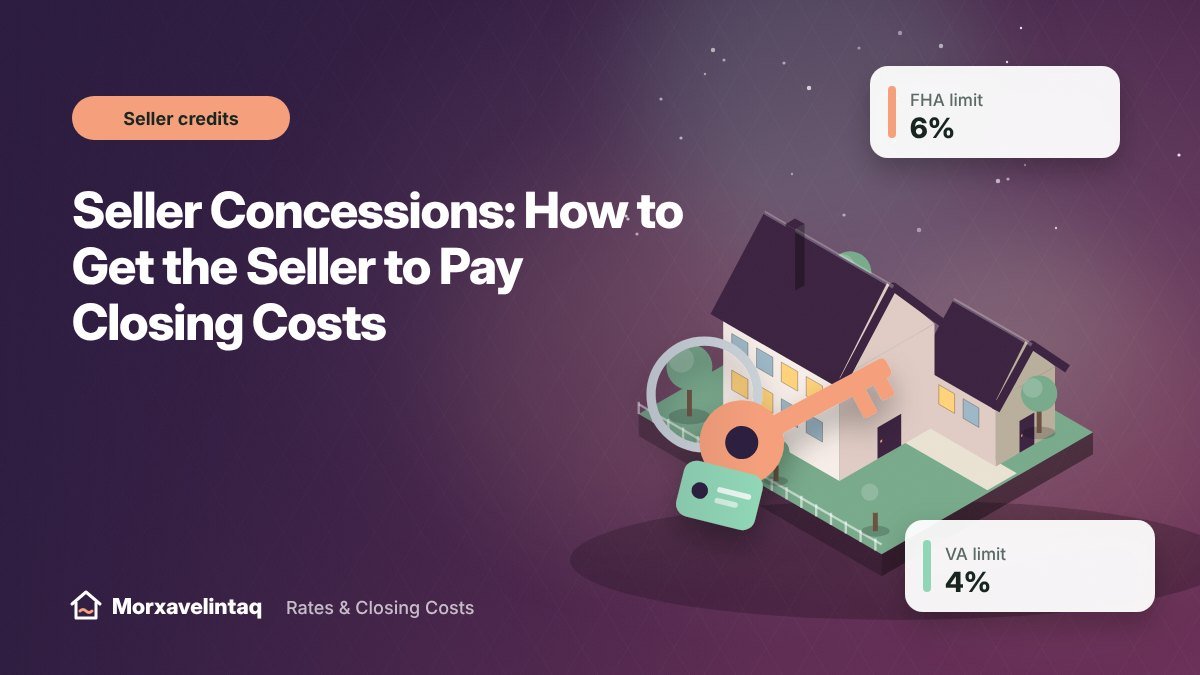
| FHA | 6% of the price |
| VA | 4% of the price in concessions; the buyer's normal closing costs can be paid in addition |
| USDA | 6% of the price |
For conventional loans, the percentage is based on the lower of the purchase price or appraised value. Lenders may apply their own limits.
What concessions can pay for
- Lender fees and third-party closing costs
- Discount points or a temporary rate buydown
- Prepaid interest, property taxes and homeowners insurance
- Initial escrow deposits
- On VA loans, things like the funding fee, paying off certain buyer debts, or prepaying property taxes count toward the 4% concession limit
They can't be used for your down payment or given to you as cash back. If the credit exceeds your actual costs, the excess is usually lost or the price must be adjusted.
Two ways to structure the request
- Ask for a credit at the same price. Offer $350,000 and ask the seller to contribute $7,000. The seller nets less.
- Increase the price to cover the credit. Offer $357,000 with a $7,000 credit. The seller nets the same, and you finance the costs over the life of the loan. The home must appraise at the higher price.
Example: a buyer using FHA purchases a $300,000 home and needs about $9,000 in closing costs. They offer $305,000 with a $9,000 seller concession, about 3% of the price and within FHA's 6% cap. The seller nets roughly $296,000 before their own costs, and the buyer needs only the down payment of about $10,700 at closing. The appraisal must come in at $305,000 or higher.
When sellers are most likely to agree
- The home has been on the market longer than average.
- Inventory is high and buyers have choices.
- The inspection reveals repairs; a credit is often easier for both sides than completing repairs before closing.
- The seller is a builder trying to move inventory; builders frequently offer rate buydowns.
Making your offer stronger
Pair the request with a strong pre-approval, a flexible closing date, and a reasonable earnest money deposit. Ask your agent to explain how the concession affects the seller's net proceeds, so the seller sees the real numbers. Check your Closing Disclosure to confirm the credit appears correctly.
How concessions affect the seller's bottom line
Sellers often react to the word "concession" before they look at the numbers. Your agent can help by framing the request in terms of net proceeds. A seller who accepts $350,000 with a $7,000 credit nets about the same as one who accepts $343,000 with no credit, before their own selling costs. If comparable homes support the higher price, the seller may prefer the higher headline number, especially if it helps them on their next purchase or with neighborhood comps.
Timing matters too. Requests made after the inspection are tied to specific findings, such as an aging water heater or a roof near the end of its life. Many sellers find a closing credit easier than scheduling contractors before closing, and buyers get control over how the repair is done. Ask your agent to attach the inspection report pages and a contractor estimate to support the amount.
What happens if the credit is more than your costs
Lenders won't let a concession exceed your actual allowable costs. If your final costs come in lower than expected, the unused portion may be lost unless the contract is amended to reduce the price or reallocate the credit. To avoid this, ask your loan officer for a realistic closing cost estimate before you write the offer, and consider using any excess for discount points to lower your rate, if your loan program allows it.
Builder incentives work a little differently
New-construction builders often advertise incentives such as "$15,000 toward closing costs or a rate buydown." These still count as interested-party contributions subject to the same program limits. Builders frequently require you to use their affiliated lender to receive the incentive. Get a quote from an outside lender too, and compare the total cost of each option, including rate, fees and the value of the incentive.
Frequently asked questions
Can a real estate agent contribute to my closing costs?
Agent contributions are generally treated as interested-party contributions and count toward the same limits. Rules vary by loan type and state.
Do concessions hurt the appraisal?
Appraisers note concessions and may consider them when comparing sales. A price increased to cover costs must still be supported by comparable sales.
Can I use concessions to buy down my rate?
Yes. Using a seller credit for discount points or a temporary buydown is common, especially with builders.